L11: Interconnection Network
Sorting a Linear Array
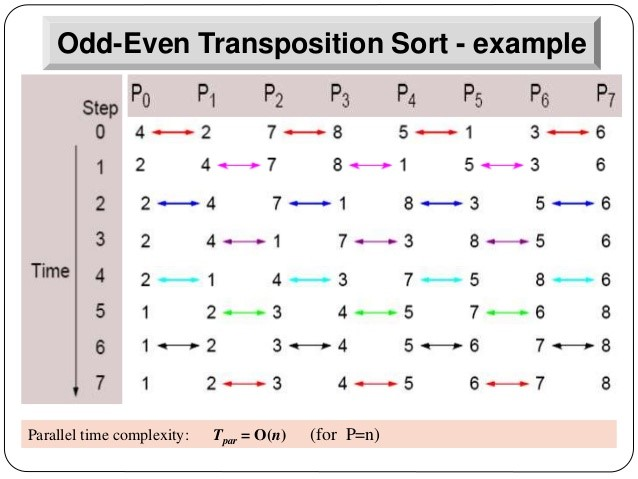
Odd-Even Transposition Sort (1D)
Shear Sort Algorithm (2D)
- Row Sorting:
- Odd Rows sort in ascending order
- Even Rows sort in descending order
- Column Sorting: All columns sort in ascending order (top to bottom)
- Repeat until sorted
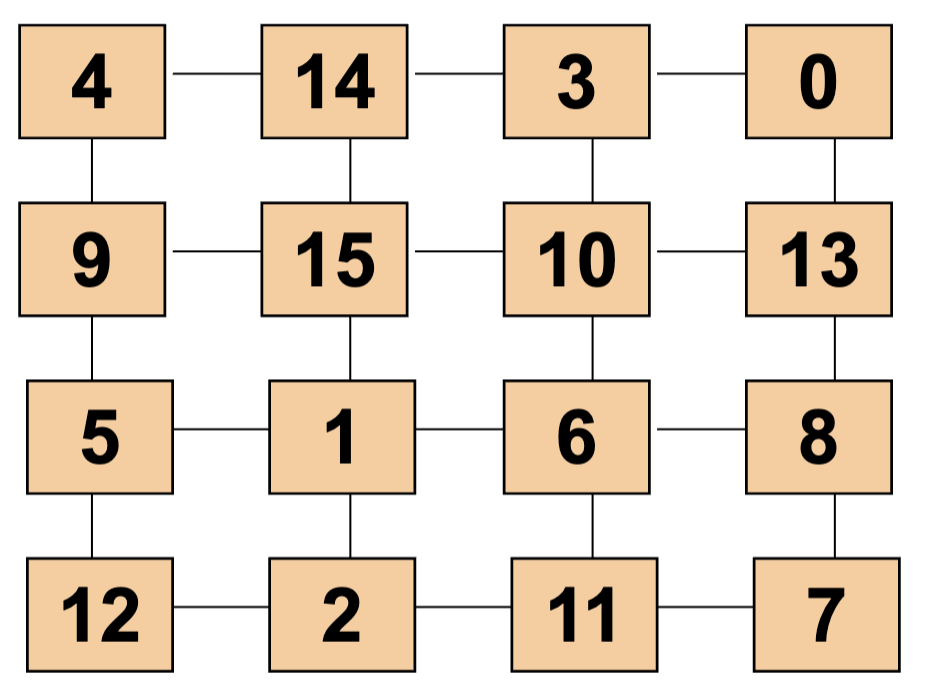
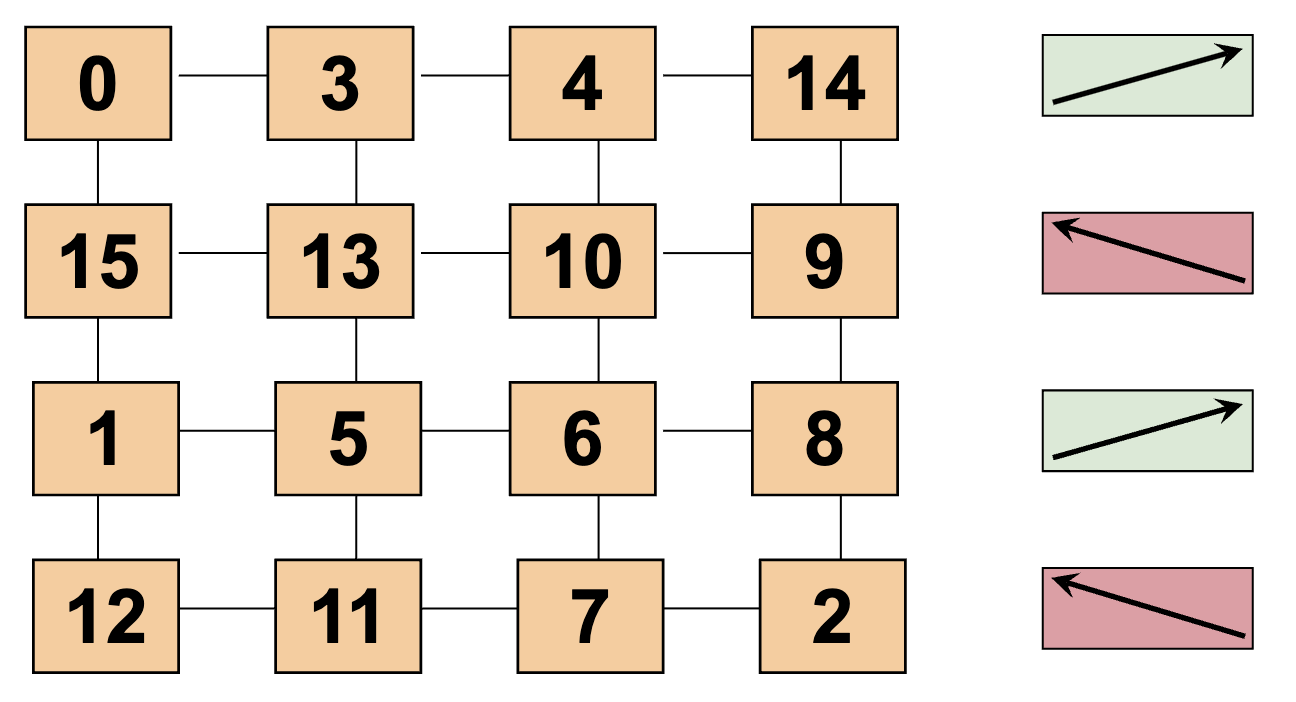
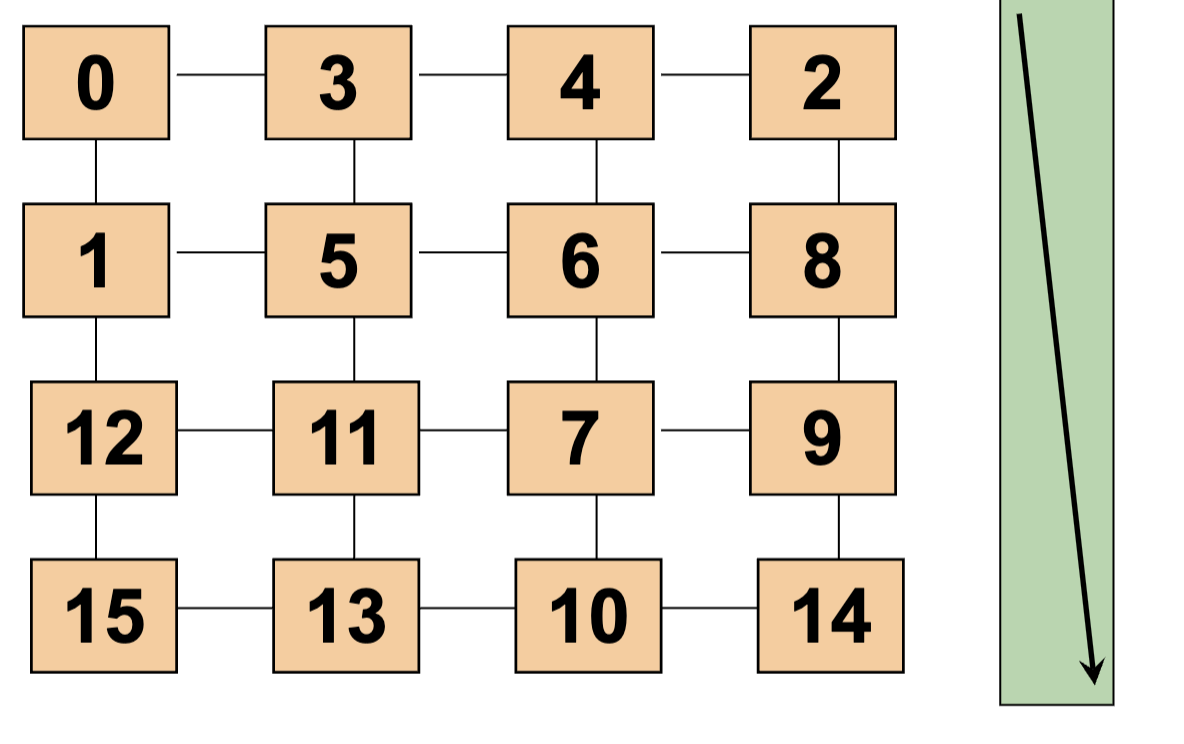
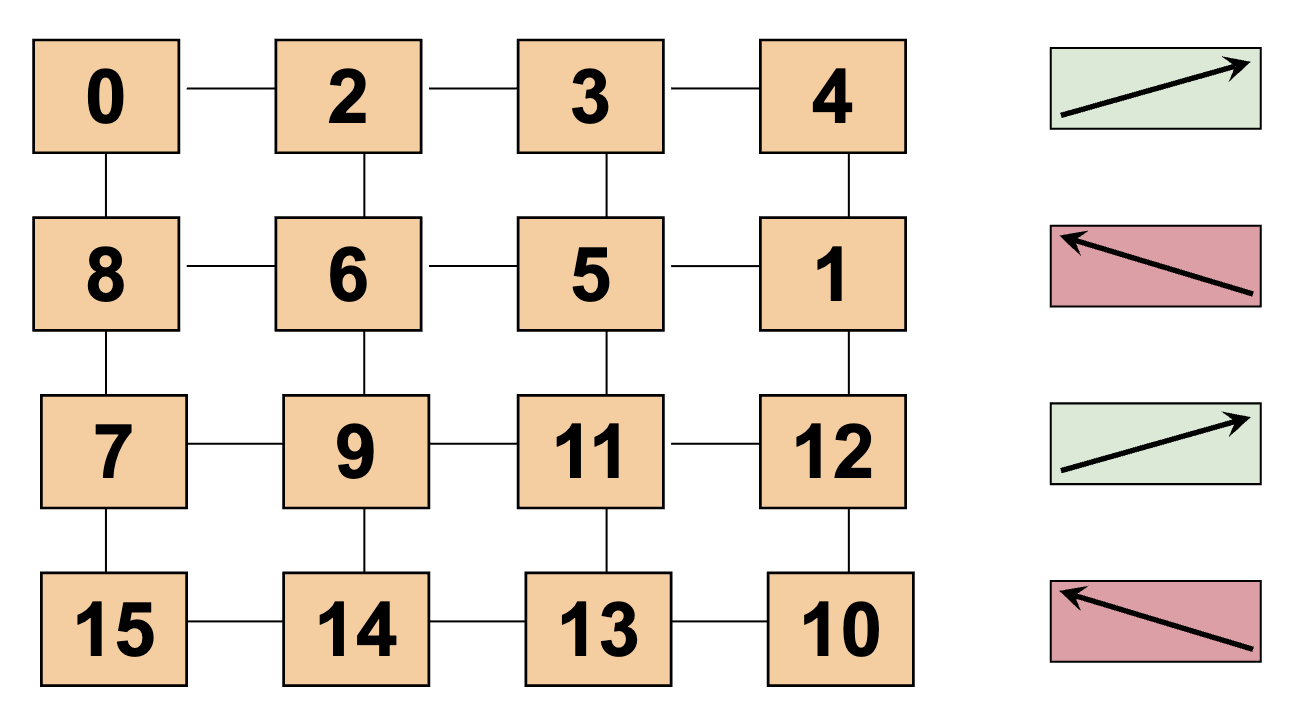
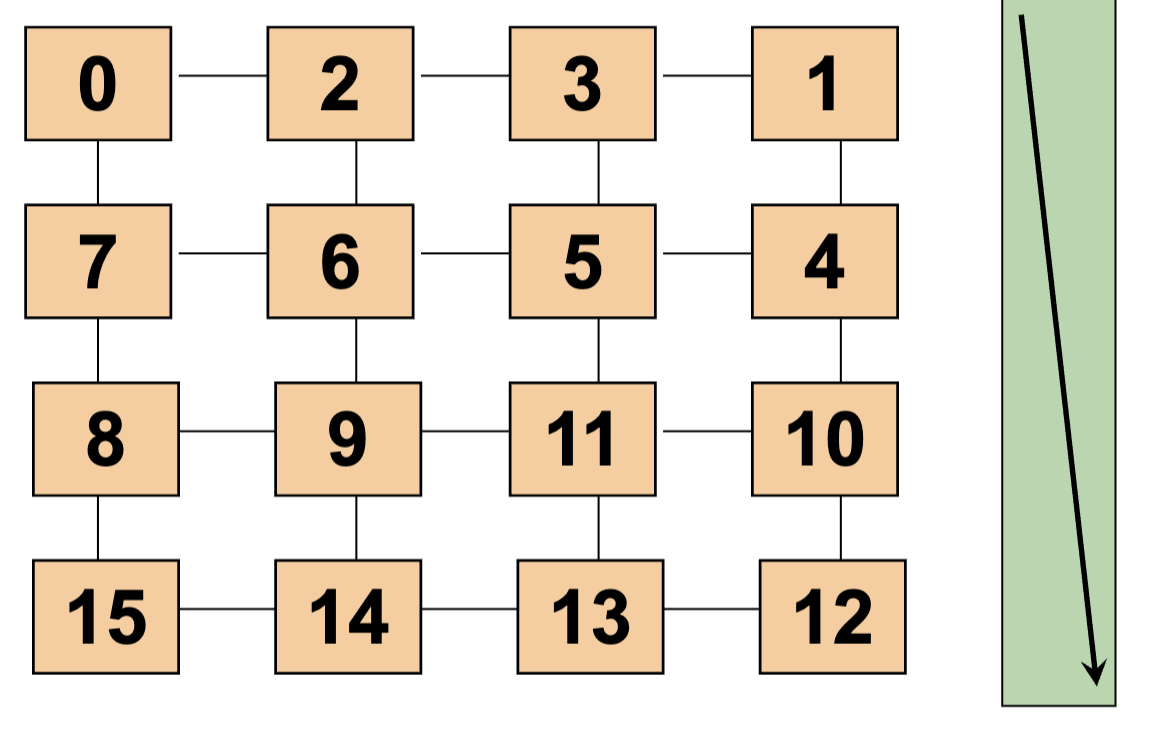
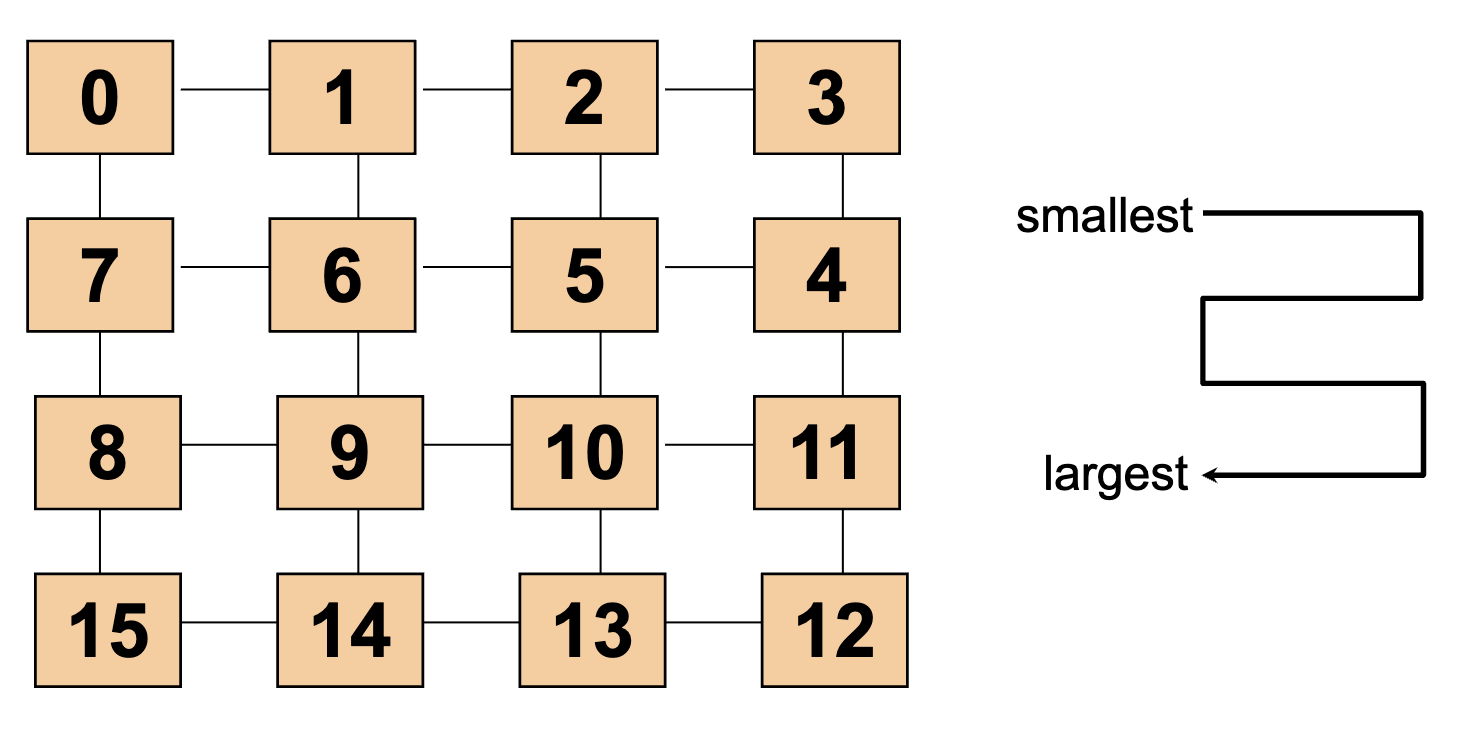
Step 5 - Sorted (snake-like arrangement)
Complexity:
Interconnection Network Impact
- System scalability – size and extensibility
- System performance and energy efficiency
- Communication speed
- Latency to memory
- Energy spent to communicate
Topology
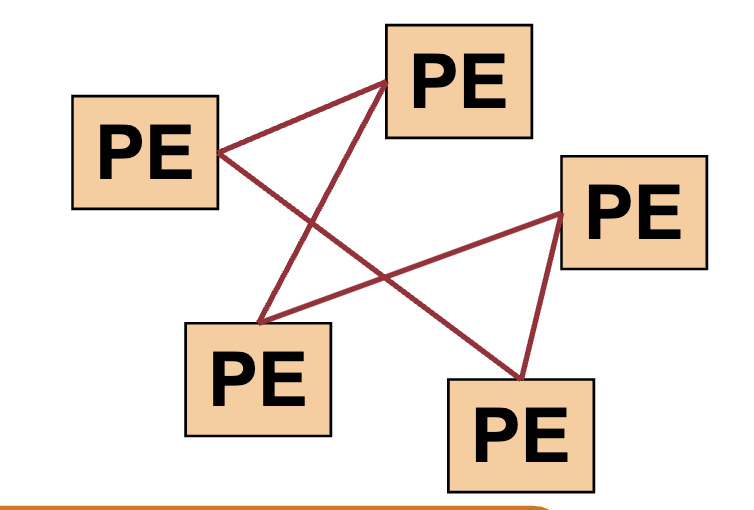
Direct Interconnection
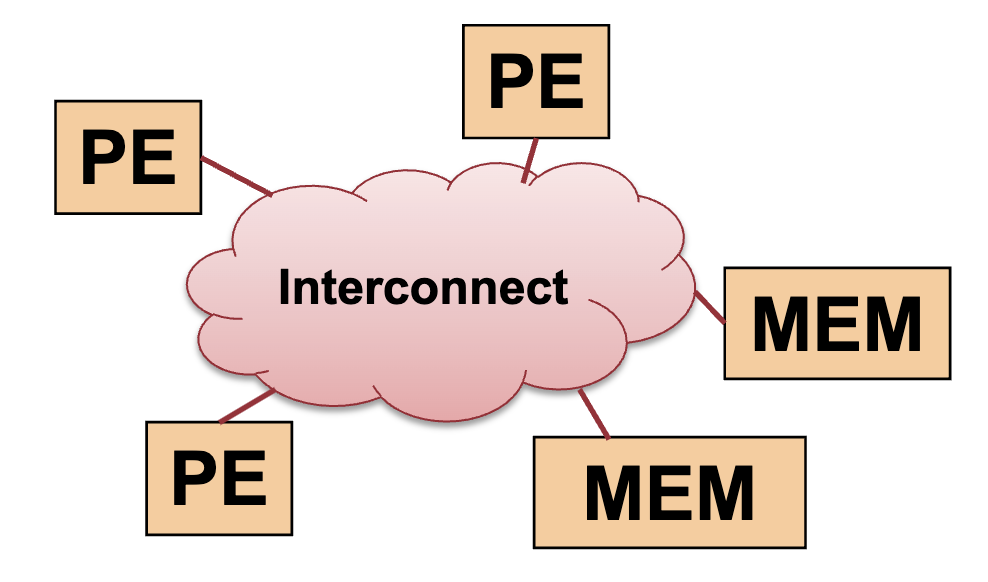
Indirect Interconnection
Direct Interconnection
- Also known as Static or Point-to-Point
- Usually endpoints are of the same type (core, memory)
Indirect Interconnection:
- Also known as Dynamic Interconnect is formed by switches
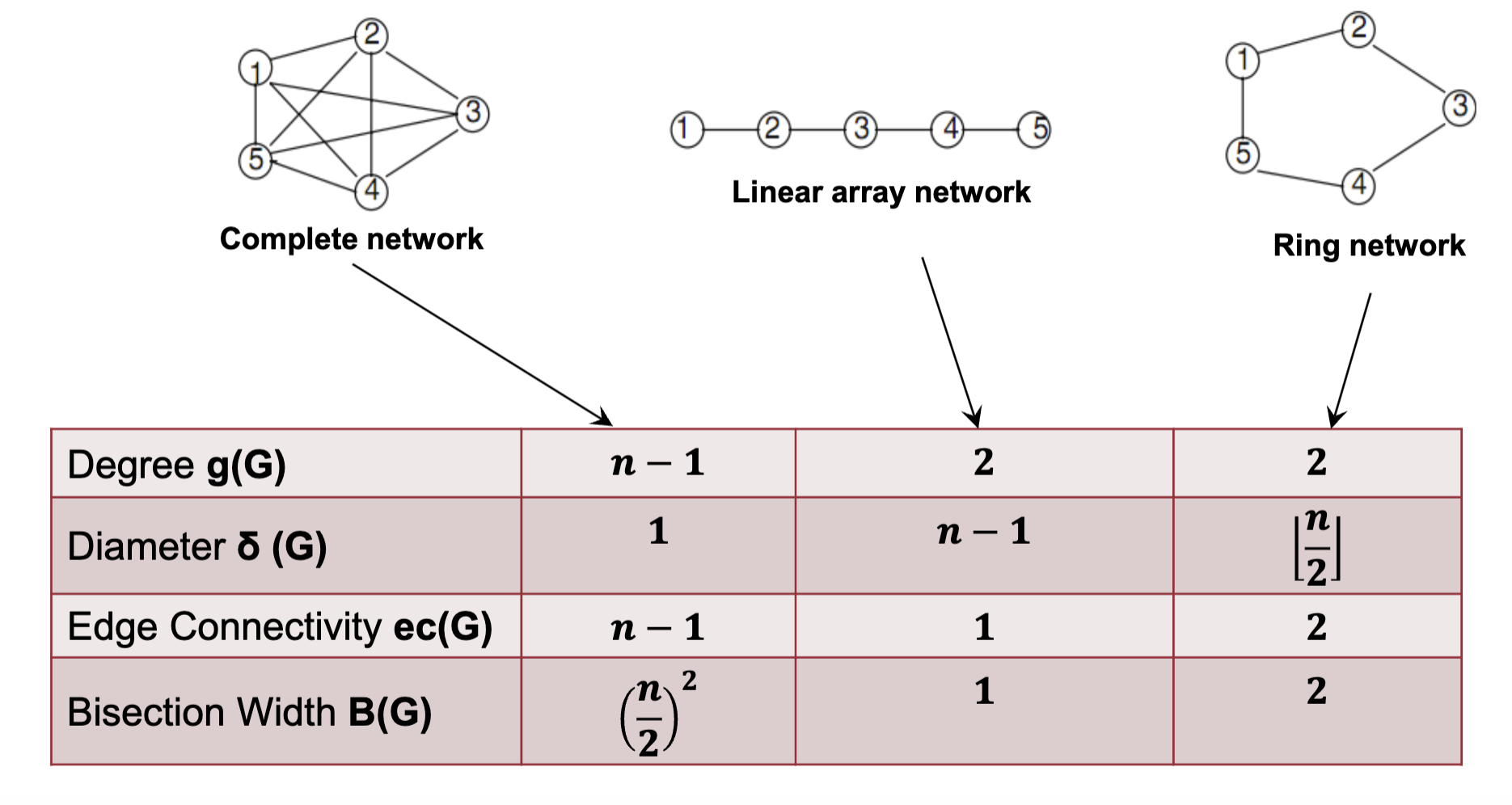
- Topology can be modeled as a Graph: G = (V, E), V = vertices; E = edges
- Metrics: Diameter, Degree, Bisection Width, Connectivity
Direct Interconnection
Diameter: Diameter : maximum distance between any pair of nodes
- Usefulness: Small diameter ensures small distances for message transmission
Degree:
- Degree g(v): number of direct neighbour nodes of node v
- Degree g(G): maximum degree of a node in a network G
- Usefulness: Small node degree reduces the node hardware overhead
Bisection Width:
- Bisection width B(G): minimum number of edges that must be removed in to divide the network into two equal halves
- Bisection bandwidth BW(G): Total bandwidth available between the two bisected portion of the network
- Usefulness: a measure for the capacity of a network when transmitting messages simultaneously
Connectivity:
-
Node connectivity: nc(G) – minimum number of nodes that must fail to disconnect the network
- Usefulness: Determine the robustness of the network
-
Edge connectivity: ec(G) – minimum number of edges that must fail to disconnect the network
- Usefulness: Determine number of independent paths between any pair of nodes
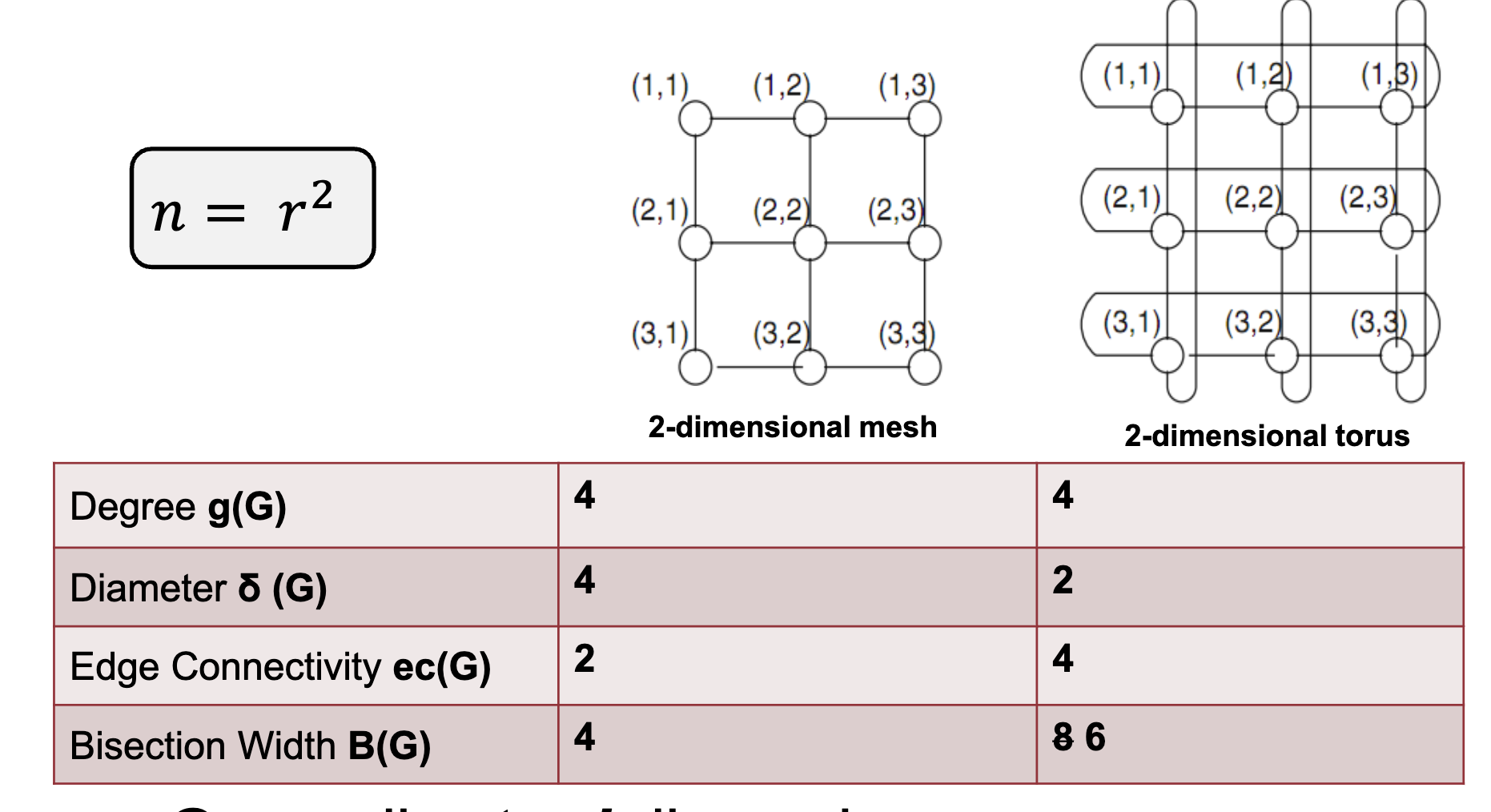
Mesh Networks - d-dimension: #nodes n = r^d
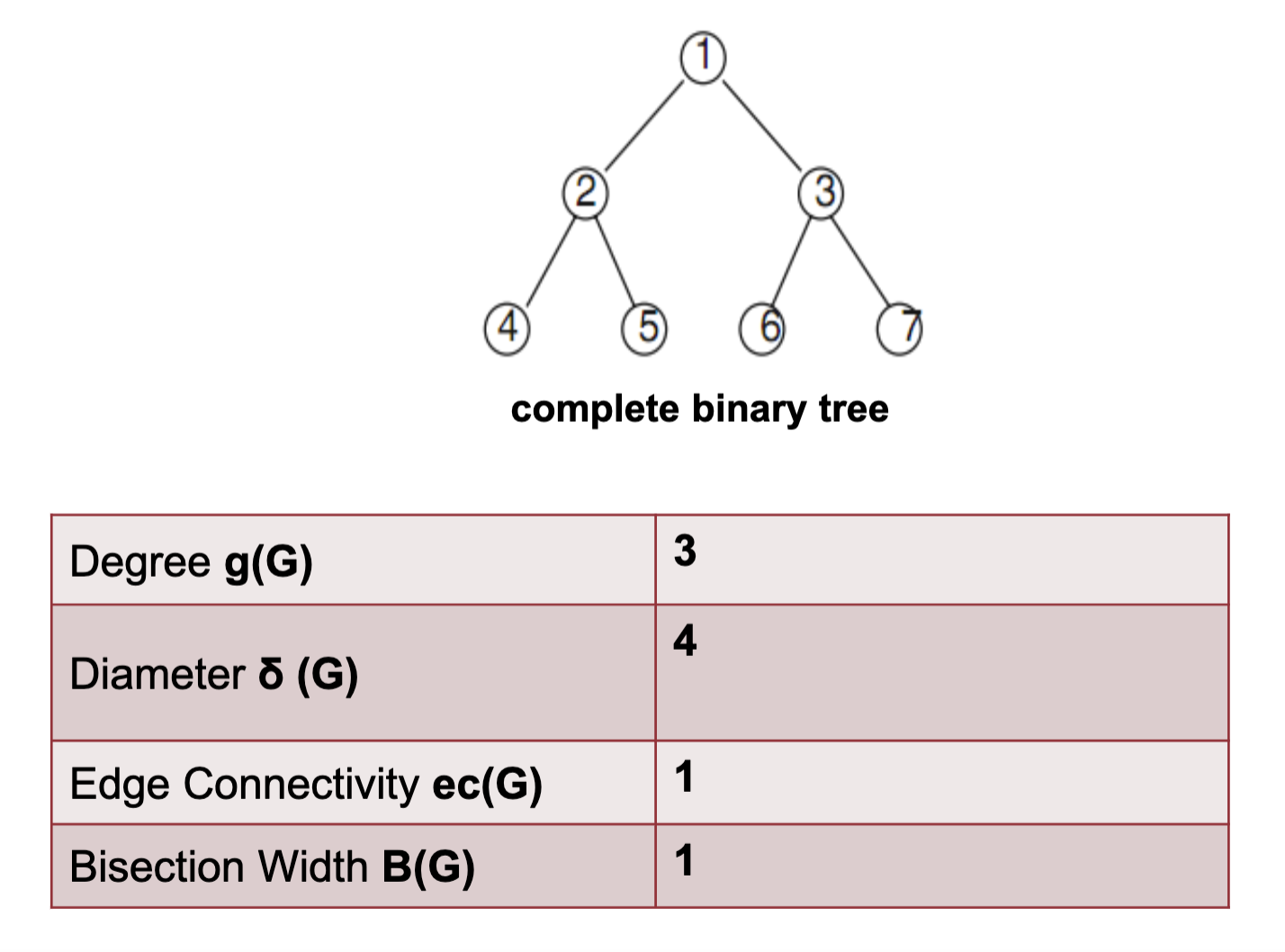
Complete Binary Tree
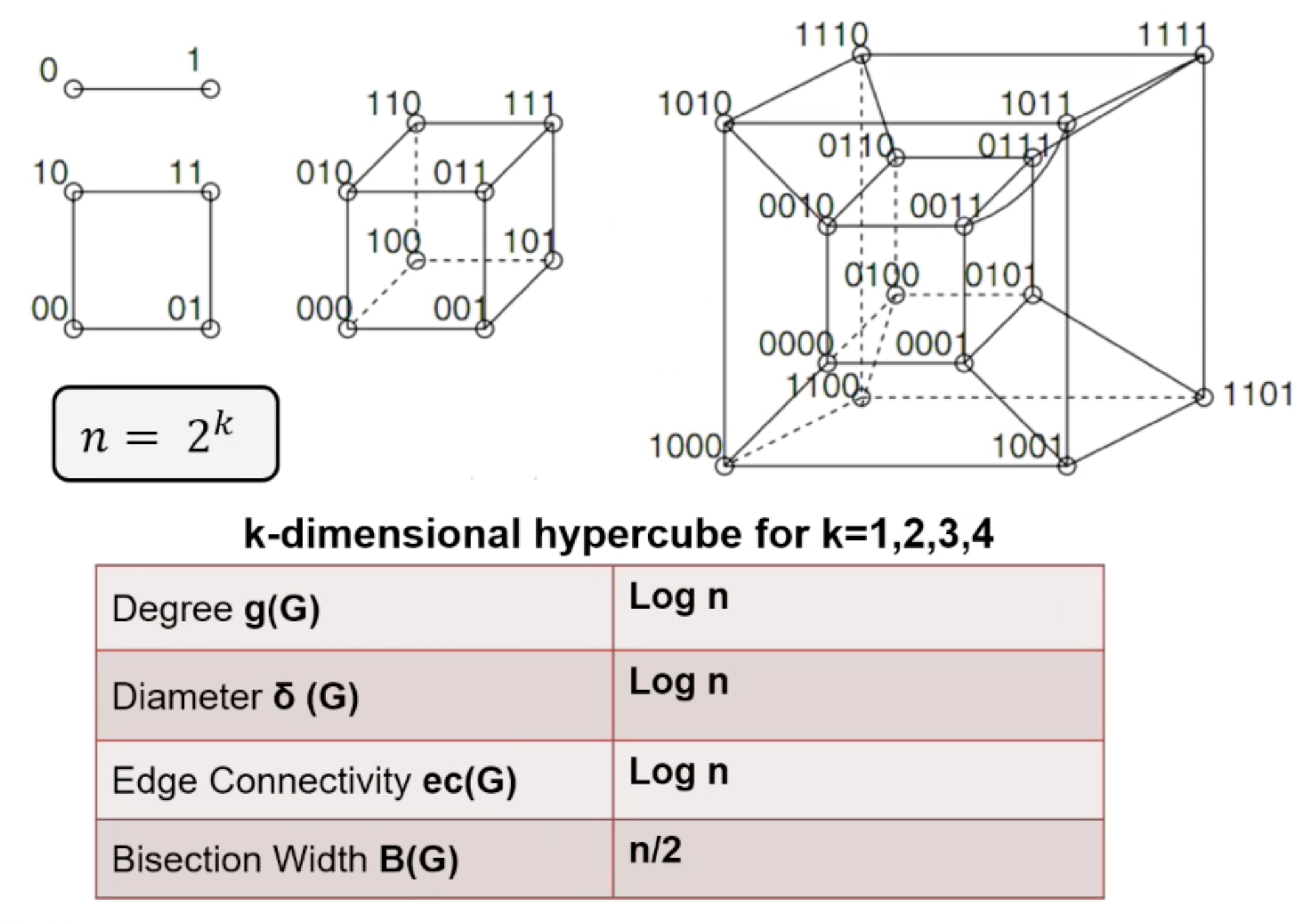
Cube-Connected-Cycles (CCC):
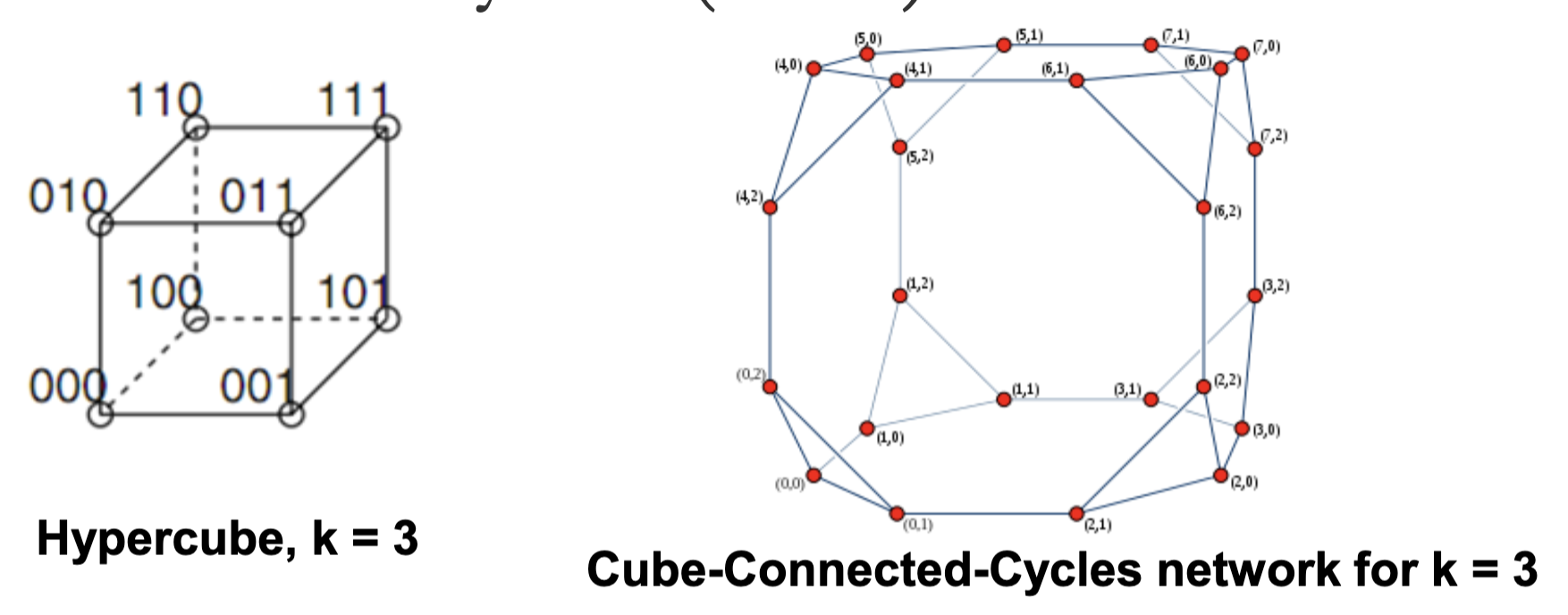
Cube-Connected-Cycles (CCC)
- From a k-dimensional hypercube (k ≥ 3), substitute each node with a cycle of k-nodes
- Each of the k-nodes take one of the original k links
- Total nodes =
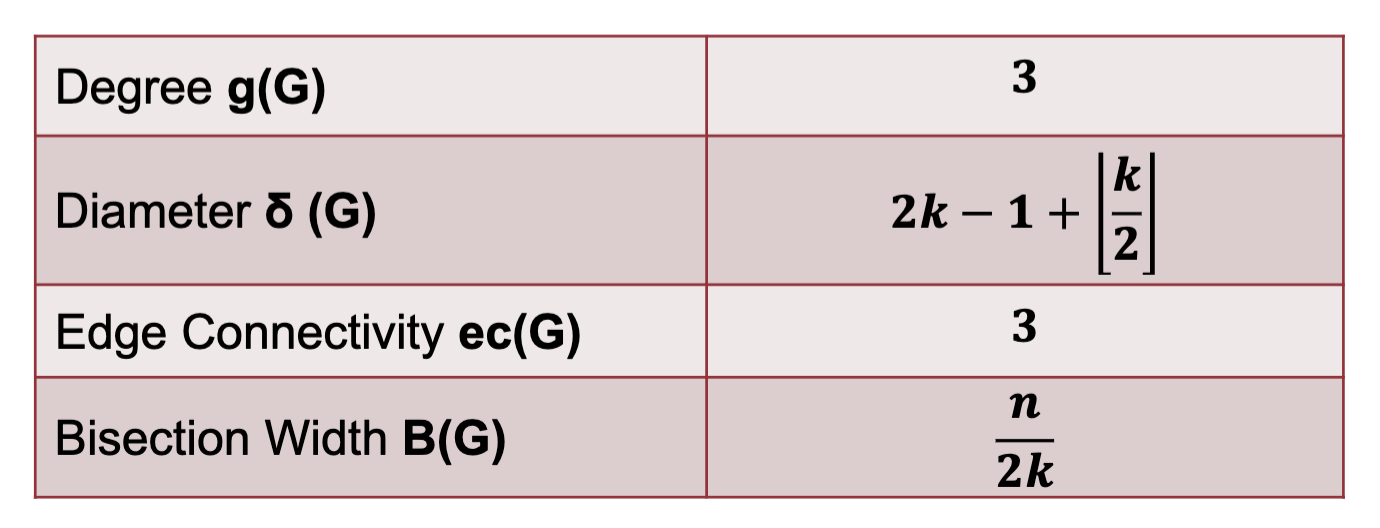
Metrics of Cube-Connected-Cycles (CCC)
- Each node in a k-dimensional CCC is labeled as (X, Y)
- X = the corresponding node index in hypercube
- Y = the position in the cycle, i.e. 0…k-1
- Node (X, Y) is connected to:
- , where is bitwise XOR (flip the ith significant bit)
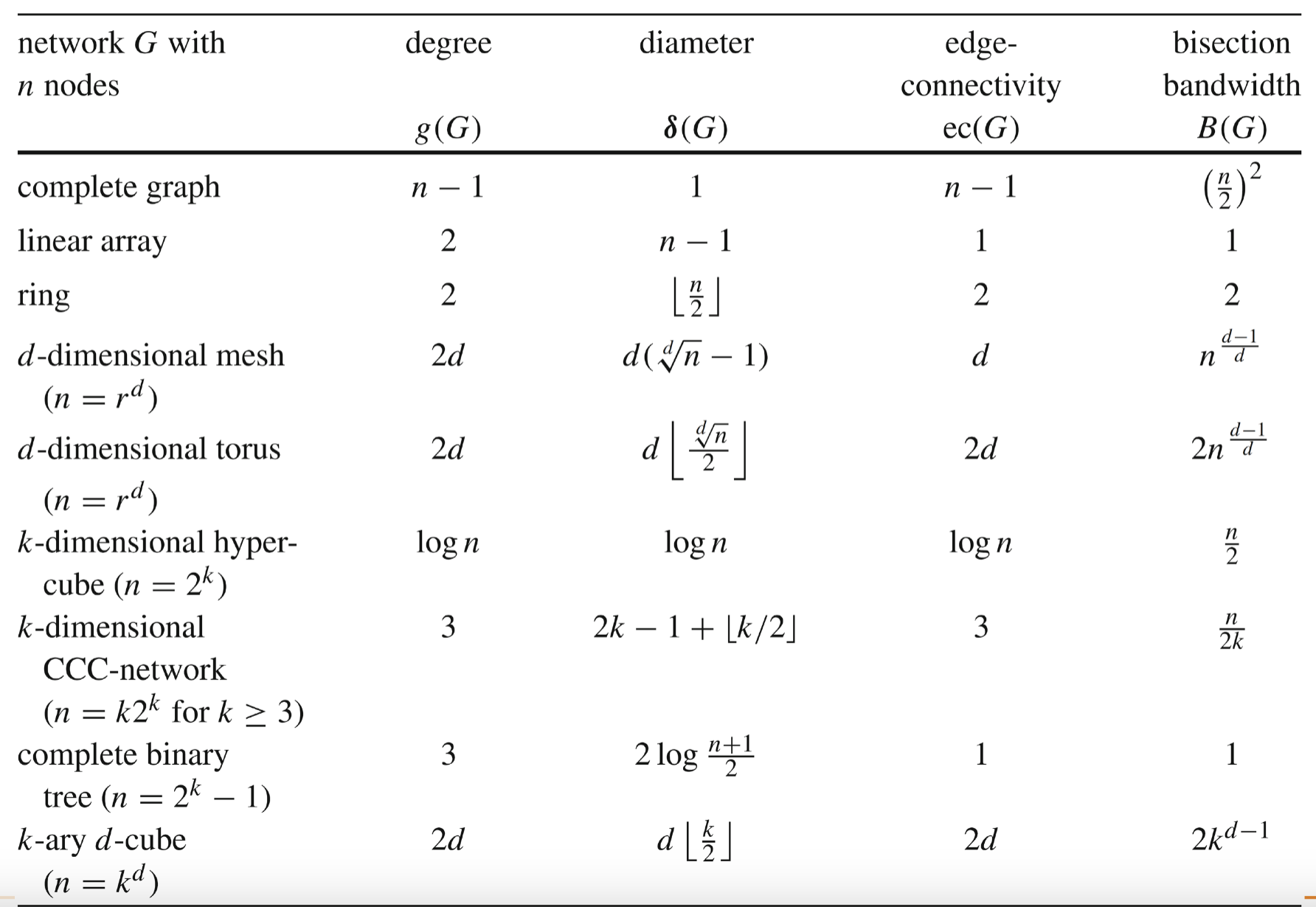
Indirect Interconnection
- Why: Reduce hardware costs by sharing switches and links
- How: Switches provide indirect connection between nodes and can be configured dynamically
- Metric: Cost (number of switches / links), Concurrent connections
Bus Network:
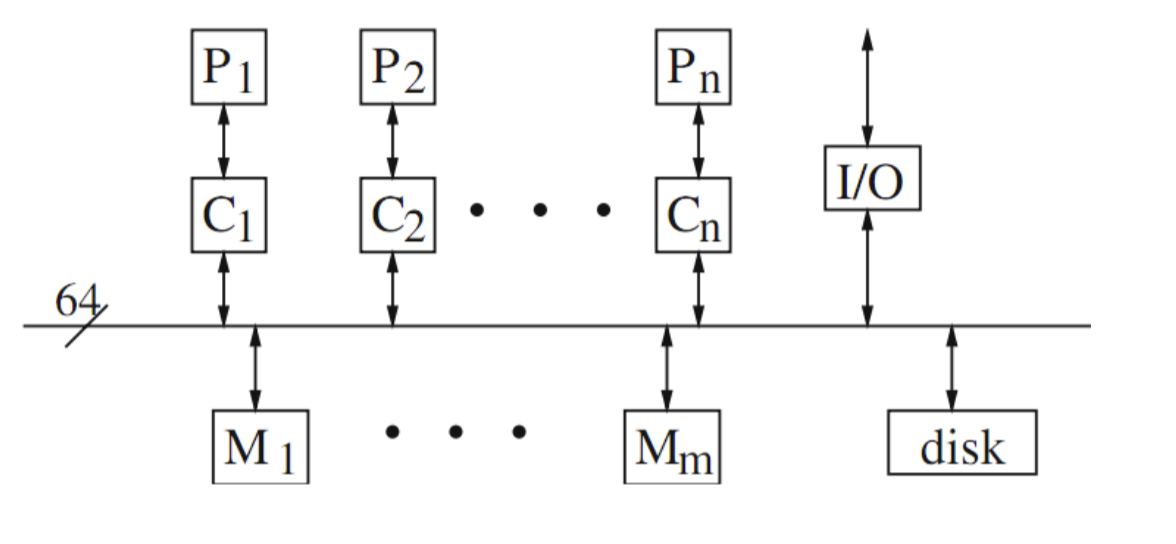
- A set of wires to transport data from a sender to a receiver
- Only one pair of devices can communicate at a time
- A bus arbiter is used for the coordination
- Typically used for a small number of processors
Crossbar Network:
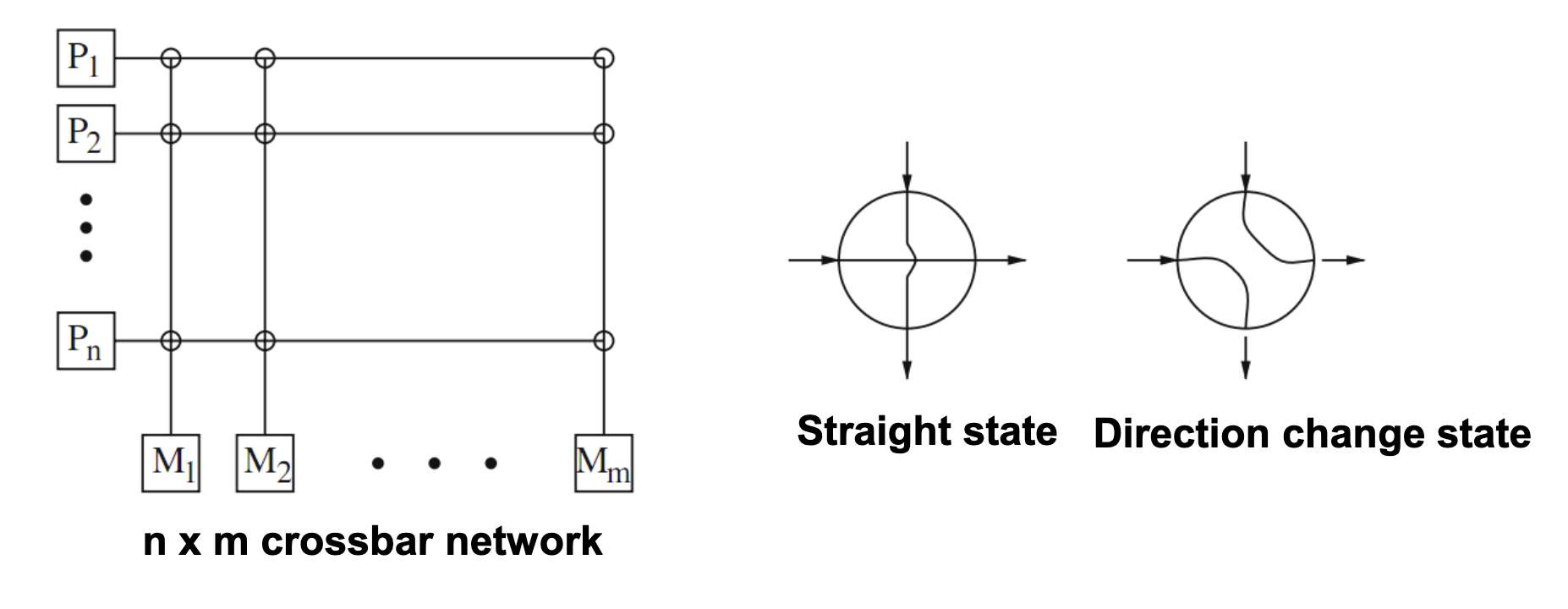
- A n × m crossbar network has n inputs and m outputs
- 2 states of a switch: straight or direction change
- Hardware is costly (n x m switches) → small number of processors
Multistage Switching Network
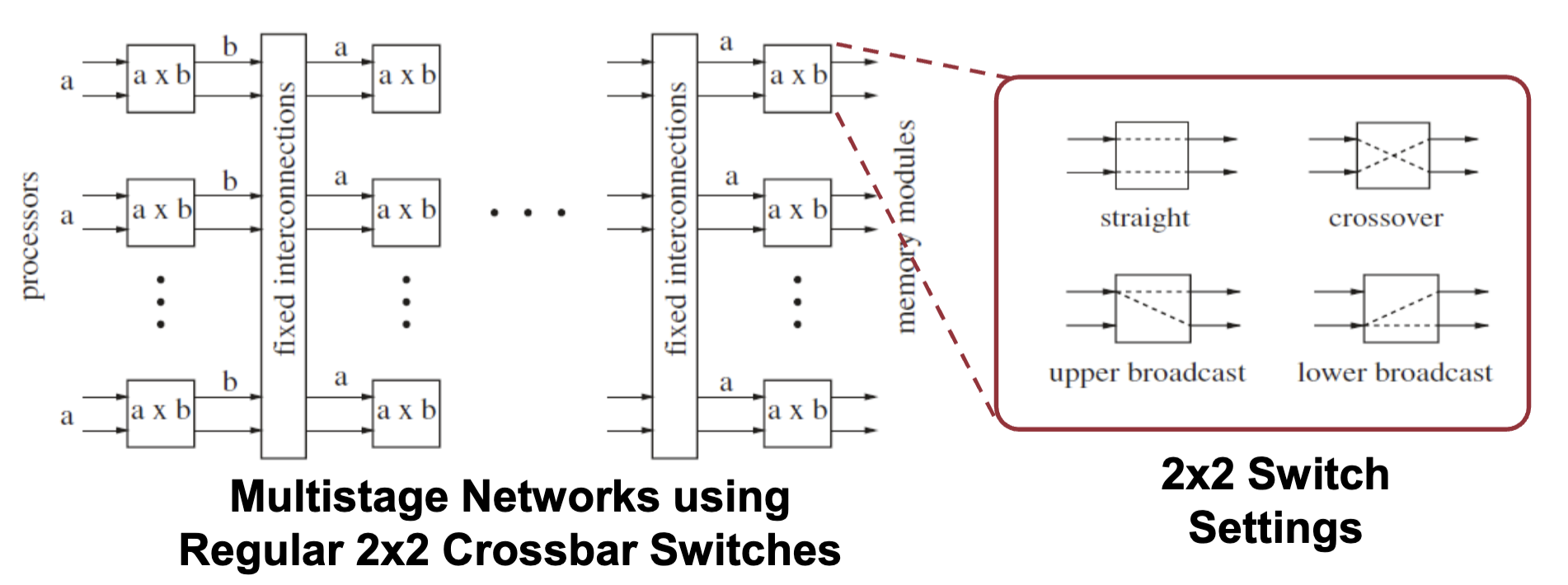
Multistage Switching Network
- Several intermediate switches with connecting wires between neighbouring stages
- Goal: obtain a small distance for arbitrary pairs of input and output devices
Omega Network:
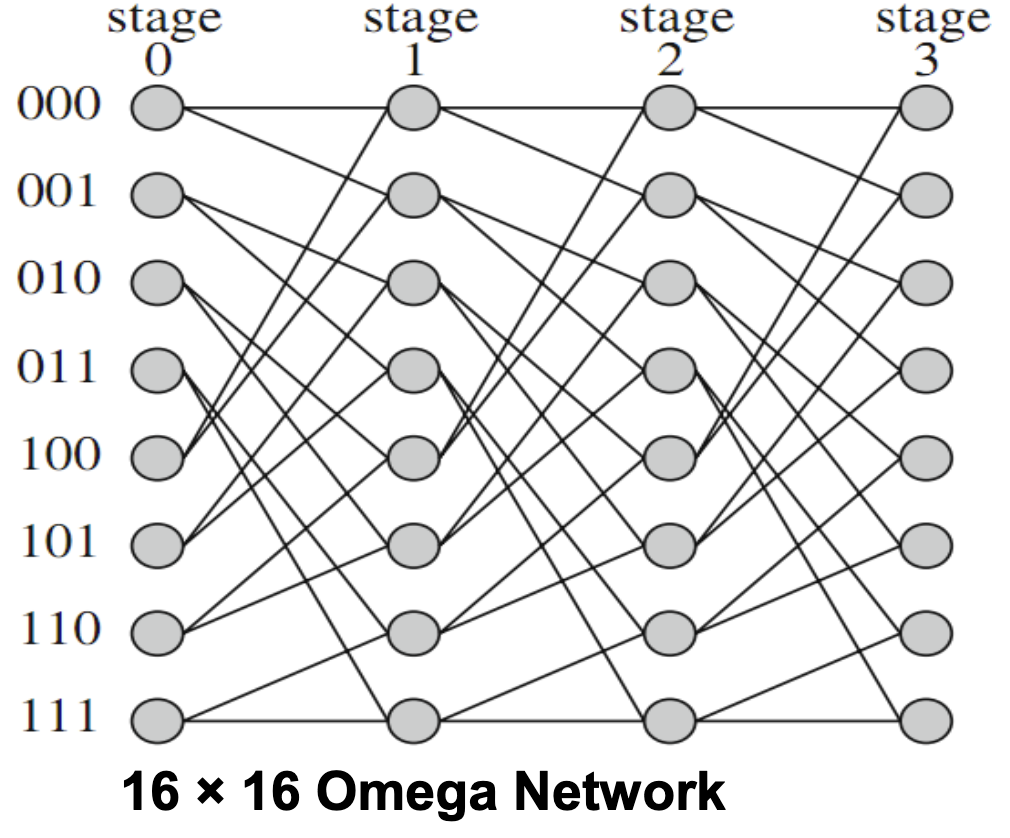
-
One unique path for every input to output
-
An n × n Omega network has log n stages
- n/2 switches per stage, each switch has 2 input and 2 output links
- Connections between stages are regular
- Also known as (lg n – 1) – dimension Omega Network
-
A switch position: (α, i)
- α: position of a switch within a stage; i: stage number
-
Has an edge from node (α, i) to two nodes (β,i + 1) where
- β = α by a cyclic left shift
- β = α by a cyclic left shift + inversion of the LSBit
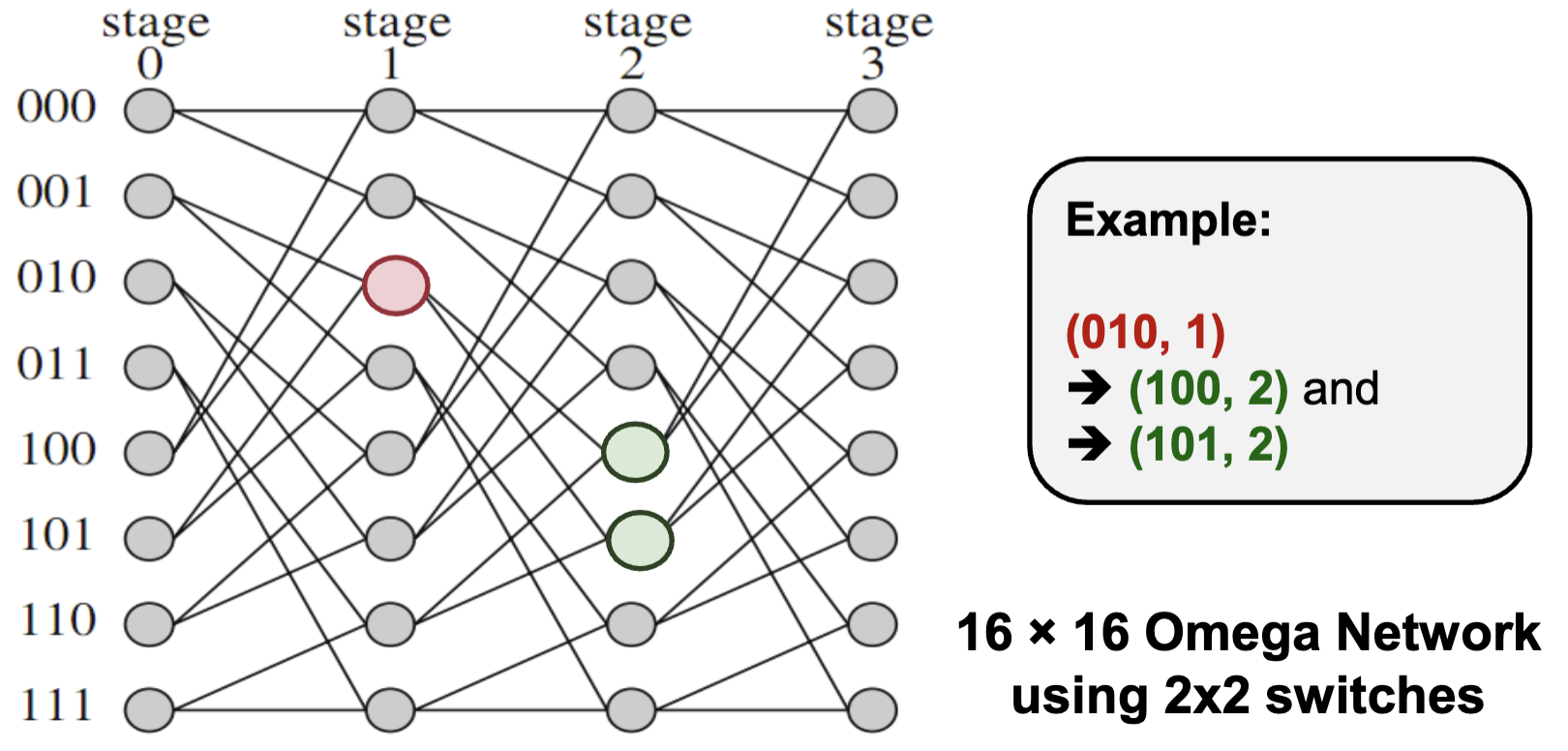
Omega Network Example
- Omega Network vs Crossbar Switches: To connect 16 processor nodes to 16 memory nodes
- Crossbar = 16 x 16 = 256 switches
- Omega: n=16 and using 2x2 switches
- Total number of switches = n/2 switches per stage * log n stages
- 32 switches
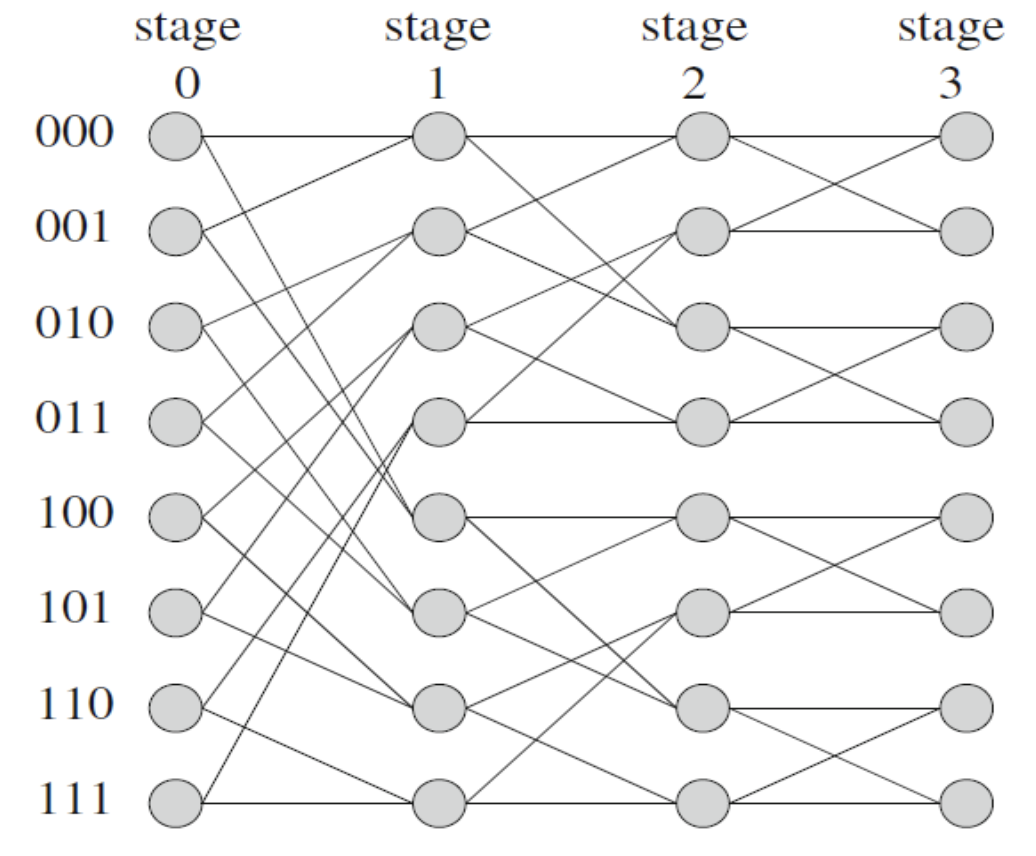
Butterfly Network:
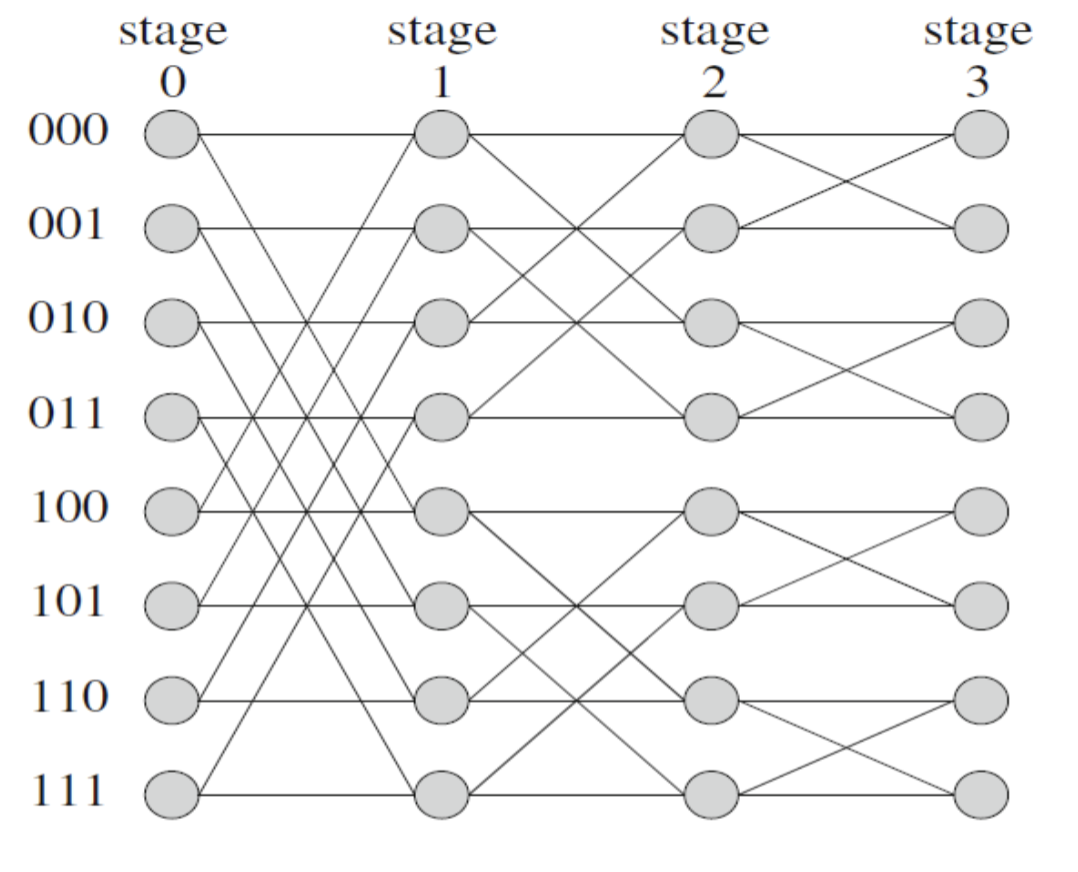
- Node (α, i) connects to
- (α, i+1), i.e. straight edge
- (α’, i+1), α and α’ differ in the (i + 1)th bit from the left, i.e. cross edge
Baseline Network: k stages
- Node (α, i) to two nodes (β, i + 1) where
- β = cyclic right shift of last (k-i) bits of α
- β = inversion of the LSBit of α + cyclic right shift of last (k - i) bits
Other networks: Beneš network, Clos network, Fat-Tree, Folded Butterfly, etc
Routing
Classification:
- Based on path length: Minimal or Non-minimal routing: whether the shortest path is always chosen
- Based on adaptivity:
- Deterministic: Always use the same path for the same pair of (source, destination) node
- Adaptive: May take into account of network status and adapt accordingly, e.g. avoid congested path, avoid dead nodes etc
XY Routing for 2D Mesh
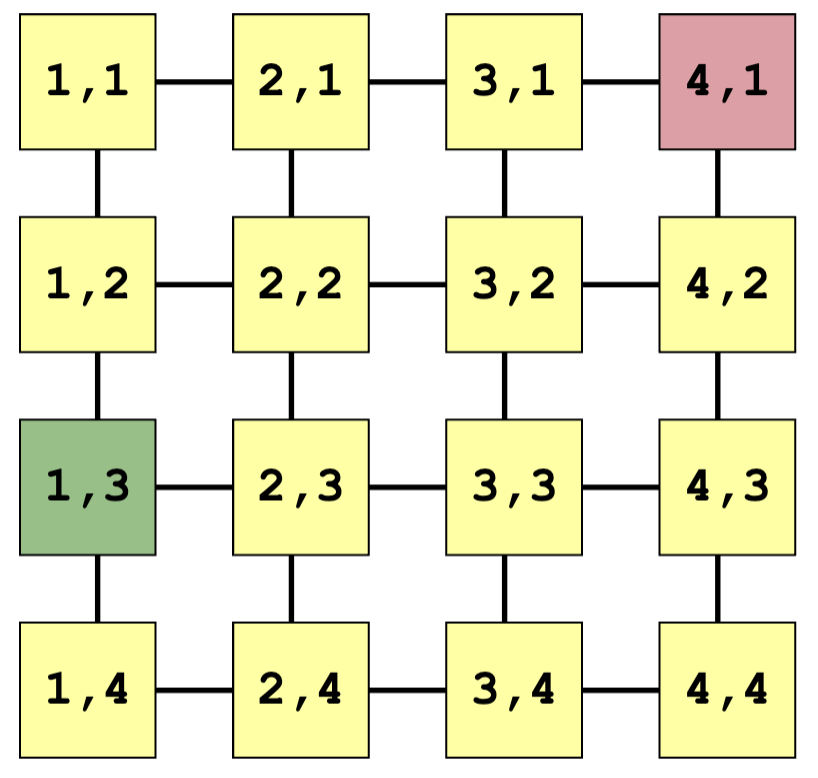
XY Routing for 2D Mesh
(X_src, Y_src) to (X_dst, Y_dst):
- Move in X direction until
X_src == X_dst - Move in Y direction until
Y_src == Y_dst
E-Cube Routing for Hypercube
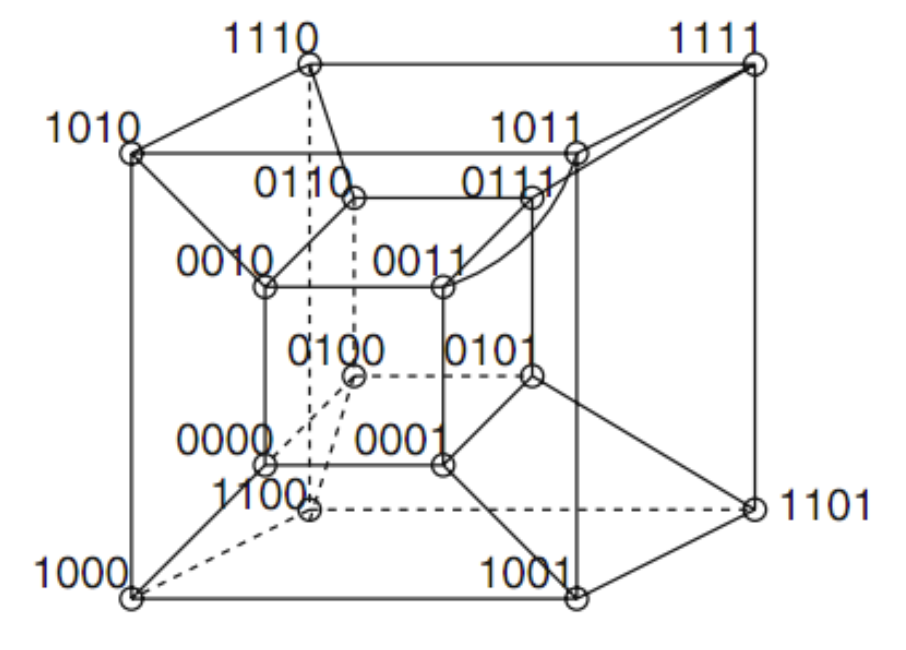
E-Cube Routing for Hypercube
Let and be the bit representations of source and destination node address respectively:
-
Number of bits difference in source and target node address → number of hops (i.e. hamming distance)
-
Start from MSB to LSB (or LSB to MSB)
-
Find the first different bit
-
Go to the neighboring node with the bit corrected
→ At most n hops
-
XOR-Tag Routing for Omega Network
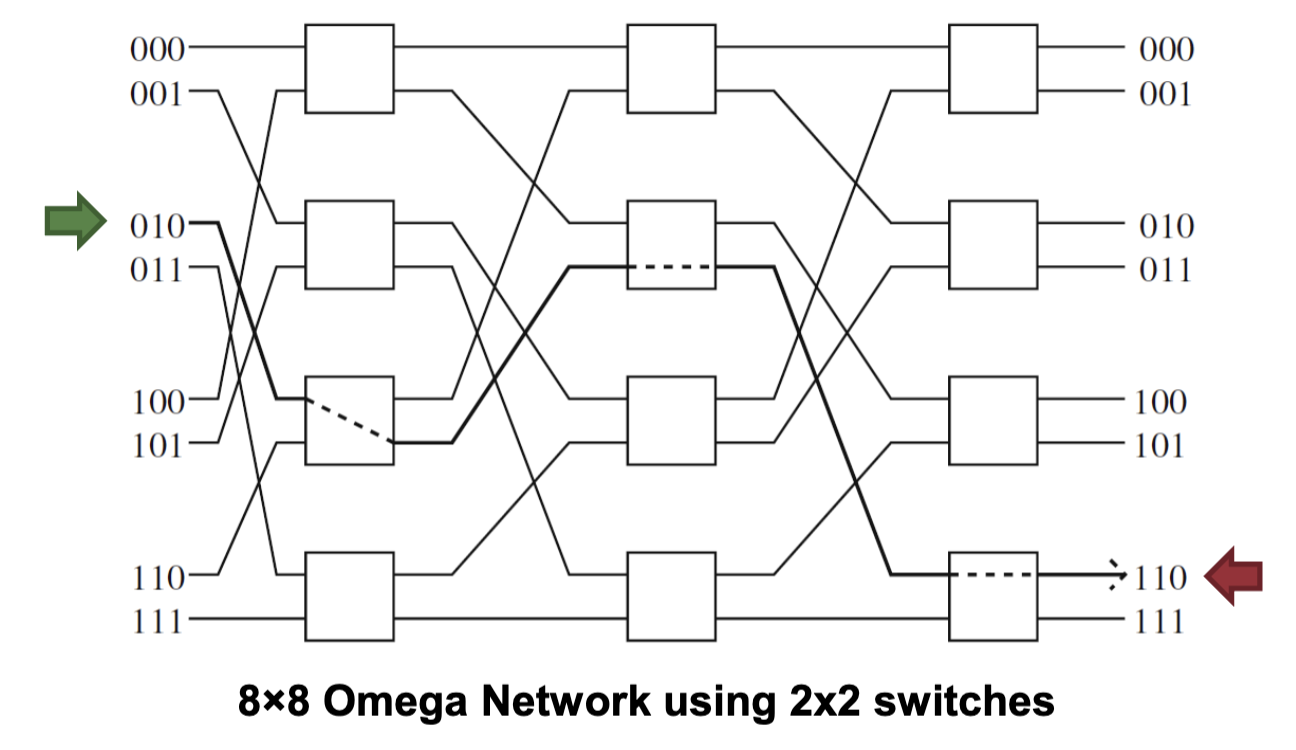
XOR-Tag Routing for Omega Network
- Let T = Source Id ⊕ Destination Id
- At stage-k:
- Go straight if bit k of T is 0
- Crossover if bit k of T is 1
Current Trends
Ethernet
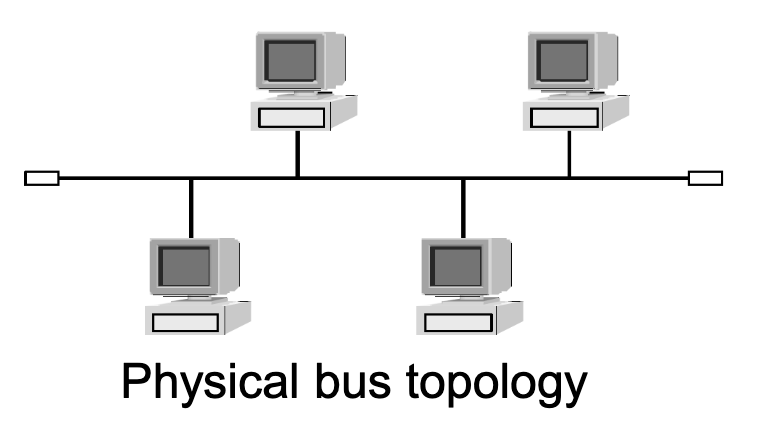
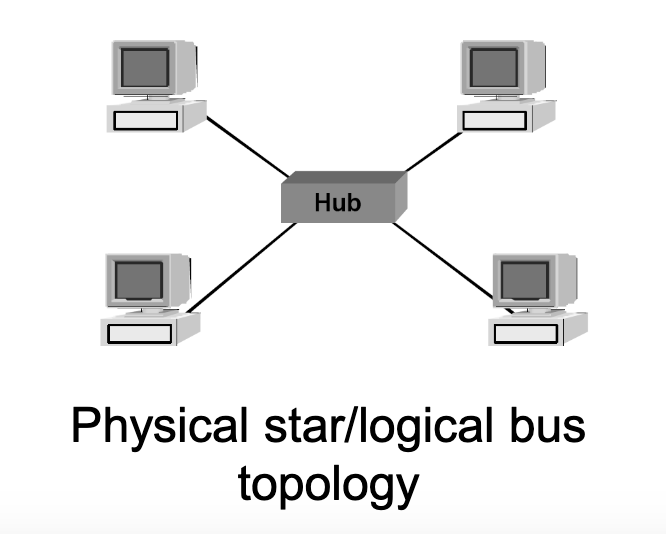
- Support point-to-point and broadcast
- Commonly-used topologies: physical bus, physical star with a logical bus, etc
InfiniBand
- Support point-to-point and multicast (on top of point-to-point capabilities)
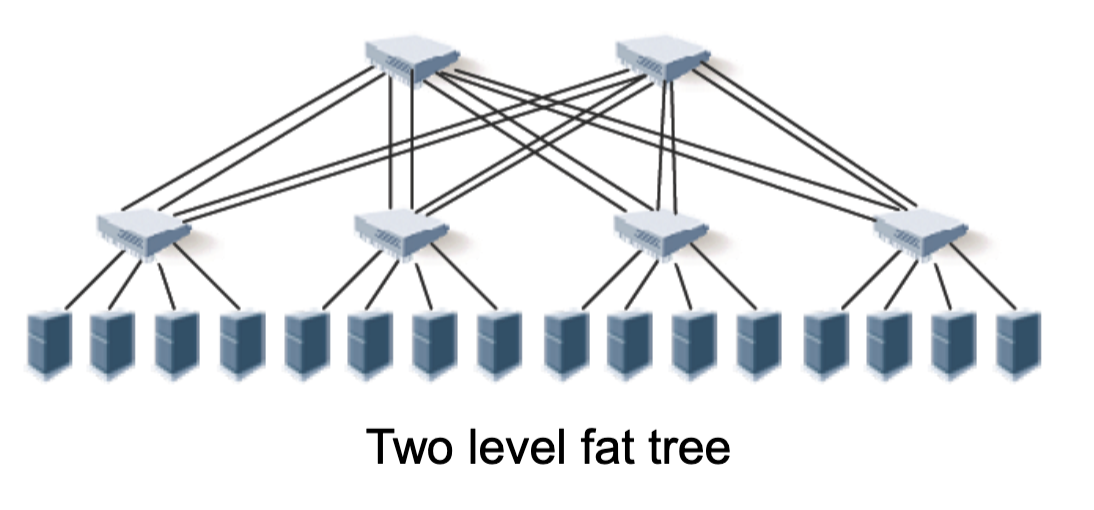
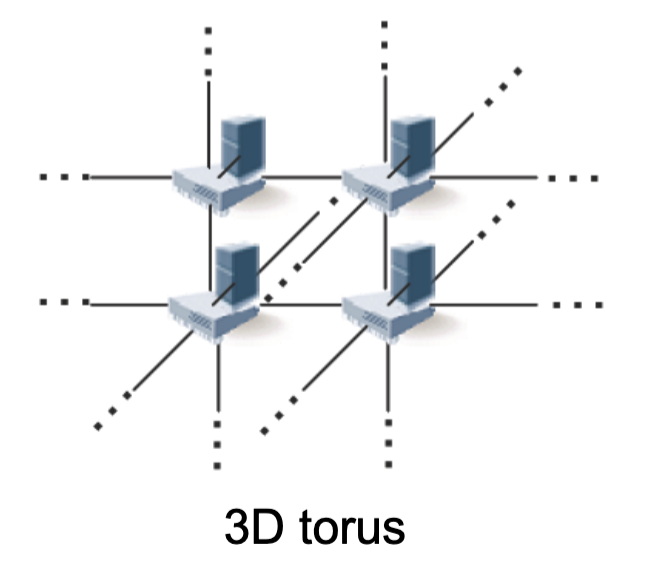
- Commonly-use topologies: Fat tree , torus, etc.