L2: Processes, Threads and Synchronization
Processes & Threads
Process
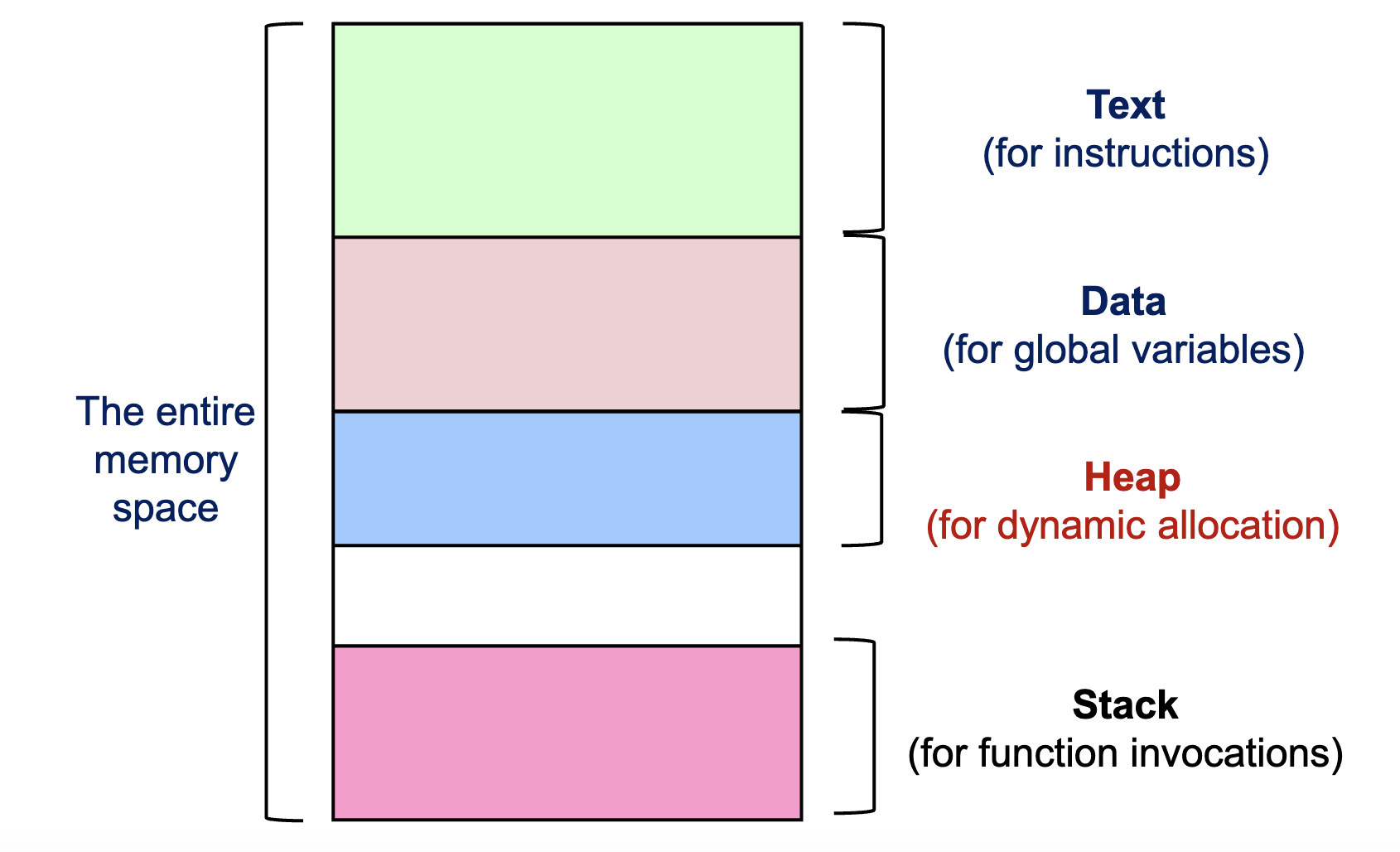
A program in execution, identified by PID
- Comprises: executable program (PC), global data (OS resources: open files, network connections), stack or heap, and current values of the registers (GPRs and Special)
- Own address space: exclusive access to its data
- Two or more processes exchange data → need explicit communication
Multi-programming (Multitasking):
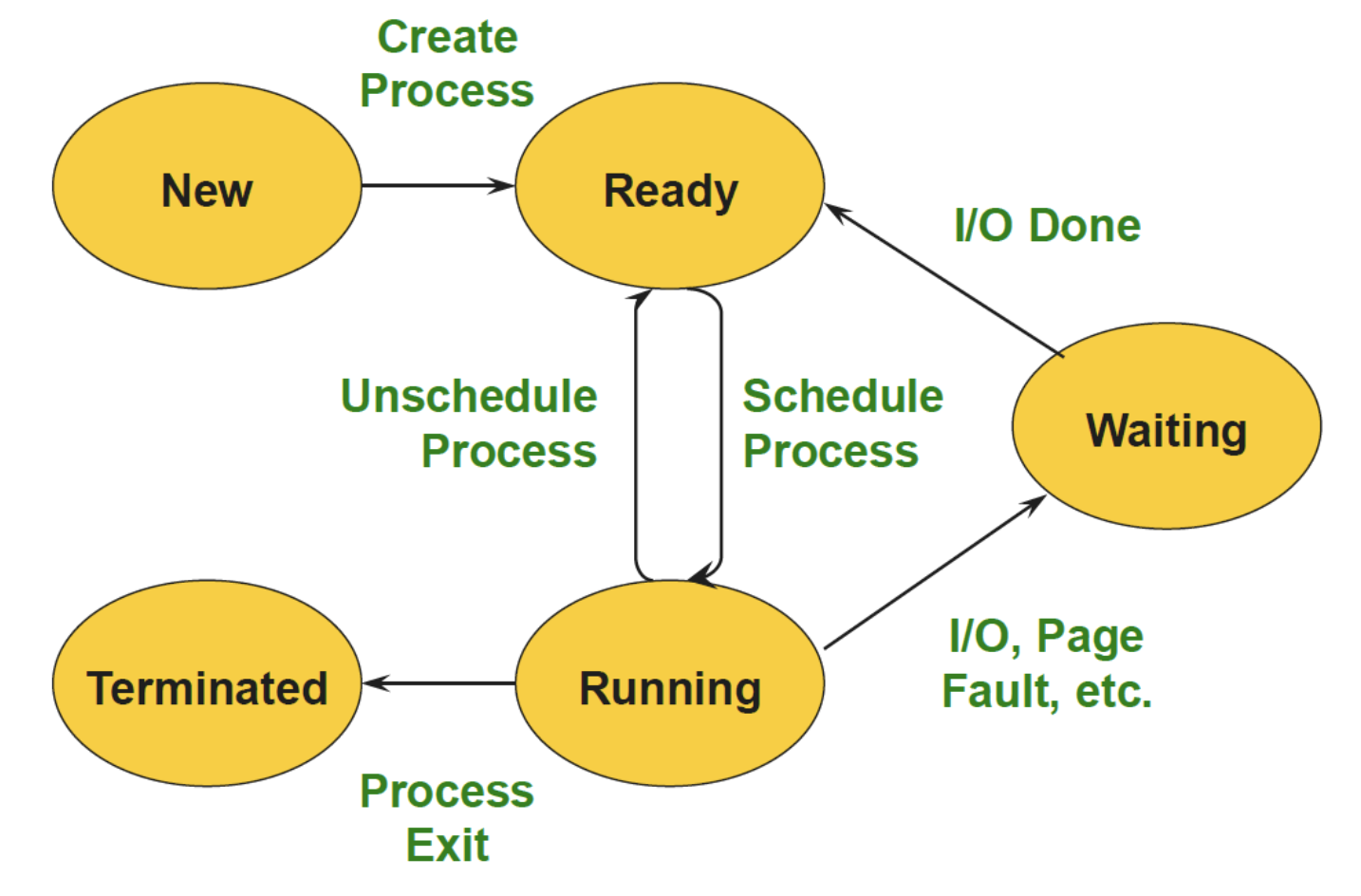
- Several processes at different stages of execution
- Need context switch
- States of the suspended process must be saved → overhead
- 2 types of execution:
- Time slicing execution → pseudo-parallelism
- Parallel execution of processes on different resources
IPC: Cooperating processes have to share information
- Shared memory → Need to protect access when reading/writing with locks
- Message passing: Blocking & non-blocking, Synchronous & asynchronous
- Unix specific: Pipes & Signal
Exceptions:
- Executing a machine level instruction can cause exception
- E.g: Overflow, Underflow, Division by Zero, Illegal memory address, Misaligned memory access
- Synchronous: Occur due to program execution
- Have to execute an exception handler
Interrupts:
- External events can interrupt the execution of a program
- Usually hardware related: Timer, Mouse Movement, Keyboard Pressed, etc
- Asynchronous: Occur independently of program execution
- Have to execute an interrupt handler
Disadvantages:
- Creating a new process is costly
- Overhead of system calls
- All data structures must be allocated, initialized and copied
- Communicating between processes costly → Go through the OS
Thread
- Extension of process model:
- A process may consist of multiple independent control flows called threads
- The thread defines a sequential execution stream within a process(PC, SP, registers)
- Threads share the address space of the process:
- All threads belonging to the same process see the same value
- shared-memory architecture
- Thread generation is faster than process generation: No copy of the address space is necessary
- Different threads of a process can be assigned run on different cores of a multicore processor
- 2 types: User-level threads, Kernel threads
User-level threads:
- Managed by a thread library – OS unaware of user-level threads so no OS support
- Advantages: switching thread context is fast
- Disadvantages
- OS cannot map different threads of the same process to different execution resources → no parallelism
- OS cannot switch to another thread if one thread executes a blocking I/O operation
Kernel threads:
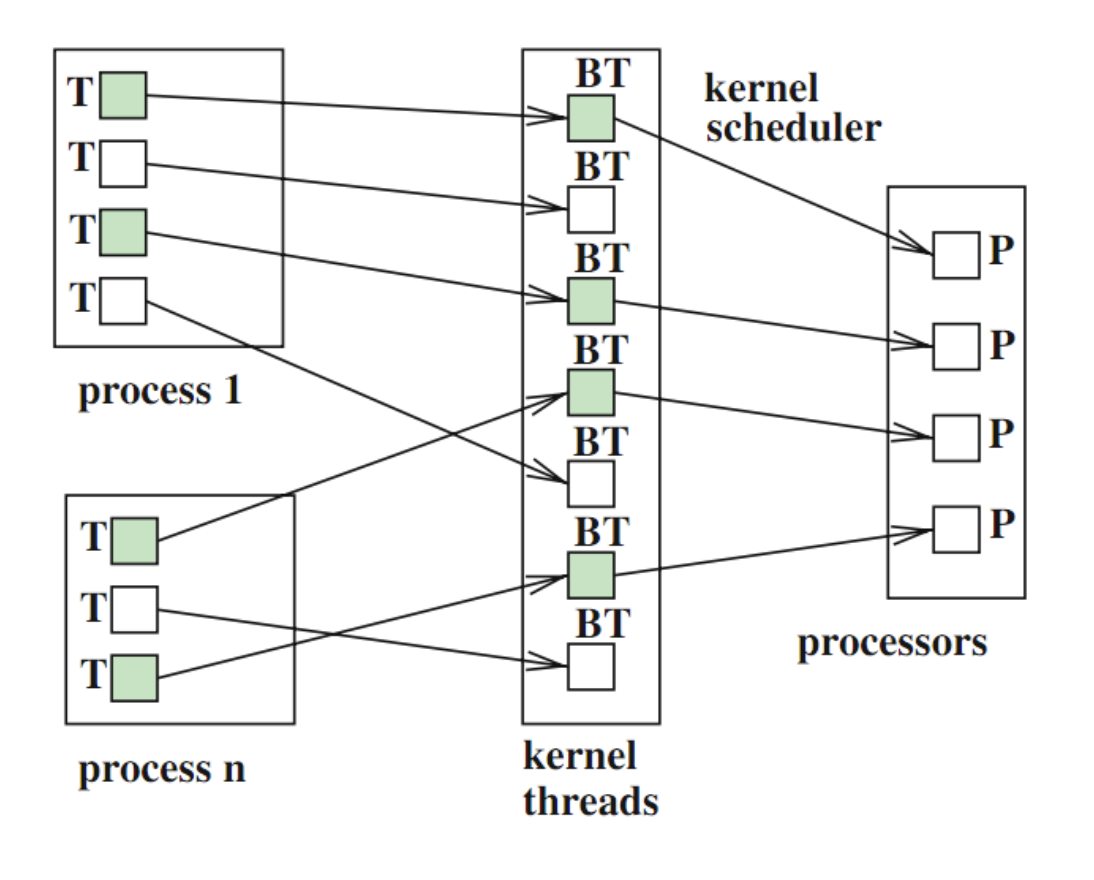
- OS is aware of the existence of threads and can react correspondingly
- Avoid disadvantages of user-level threads
- Efficient use of the cores in a multicore system
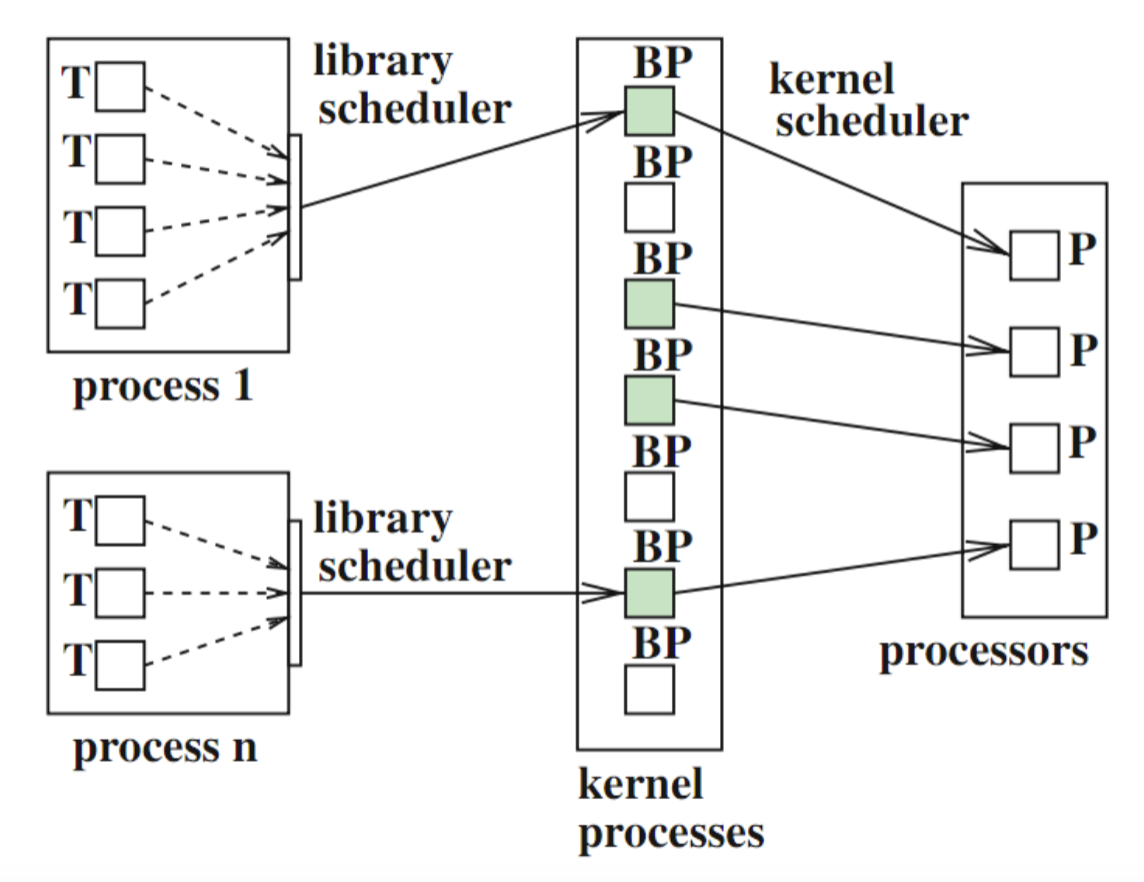
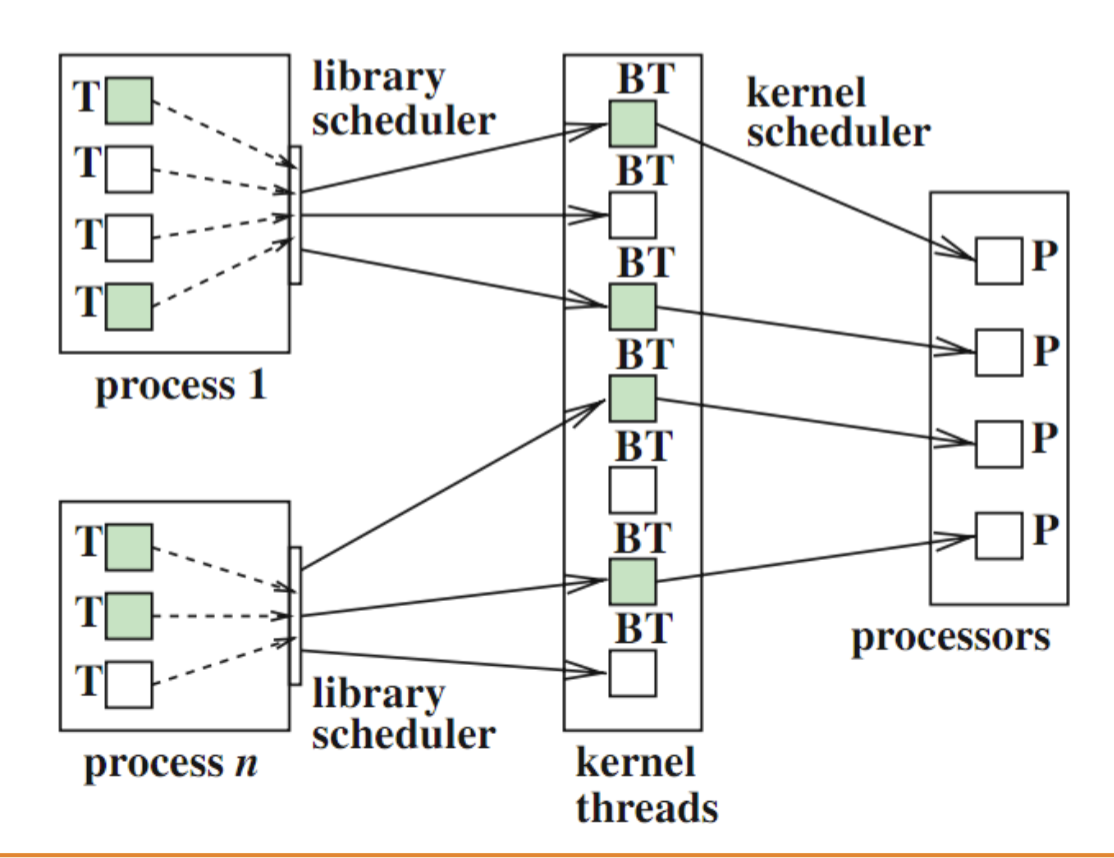
many-to-many mapping
Synchronization
Synchronization mechanisms
Lock:
acquire()andrelease()- Locks can spin (a spinlock) or block (a mutex)
Semaphores
Semaphore::Wait(): decrement (alsoP())Semaphore::Signal(): increment, (alsoV())- Semaphore value is always greater than or equal to 0
- Mutex semaphore (or binary semaphore): count = 1
- Counting semaphore (or general semaphore): count = N
Barrier:
Synchronization problems
Deadlock: exist if and only if the following four conditions hold simultaneously:
- Mutual exclusion – At least one resource must be held in a non-sharable mode
- Hold and wait – There must be one process holding one resource and waiting for another resource
- No pre-emption – Resources cannot be pre-empted (critical sections cannot be aborted externally)
- Circular wait – There must exist a set of processes [P1, P2, P3,…,Pn] such that P1 is waiting for P2, P2 for P3, etc
Starvation: side effect of the scheduling algorithm
- A high priority process always prevents a low priority process from running on the CPU
- One thread always beats another when acquiring a lock
Livelock:
Classic Synchronization Problems
Producer-consumer:
mutex = Semaphore(1);items = Semaphore(0)
1event = waitForEvent()2mutex.wait()3
4buffer.add(event)5
6items.signal()7mutex.signal()1items.wait()2mutex.wait()3
4event = buffer.get()5
6mutex.signal()7event.process()Producer-consumer with Finite Buffer:
1event = waitForEvent()2spaces.wait()3mutex.wait()4
5buffer.add ( event )6
7mutex.signal ()8items.signal ()1items.wait()2mutex.wait()3
4event = buffer.get()5
6mutex.signal()7spaces.signal()8event.process()Readers-writers Problem:
- Any number of readers can be in the critical section simultaneously
- Writers must have exclusive access to the critical section
int readers = 0,mutex = Semaphore (1),roomEmpty = Semaphore (1)
1roomEmpty.wait()2# critical section for writers3roomEmpty.signal()1mutex.wait ()2readers += 13if readers == 1:4 roomEmpty.wait () # first in locks5
6mutex.signal ()7# critical section for readers8mutex.wait ()9
10readers -= 111if readers == 0:12 roomEmpty.signal () # last out unlocks13mutex.signal ()