L9: Pricing Models and Modeling TCO
Pricing Models
- Defines unit cost of resource usage according to usage cost metrics
- Factors influencing price model
- overhead in design, development, deployment and operation of cloud services and other IT resources
- opportunities to reduce expenses via IT resource sharing and data center optimization
- market competition and regulatory requirements
Variables in a Pricing Model
- Cost metrics and associated prices → depends on on-demand (pay-per-use) or reserved allocation (upfront fee + discounted hourly rate)
- Definition of fixed (usage quota) and variable (actual usage) rates
- Discounts for higher volumes
- Payment options and schedules: customization, prepaid, postpaid, instalment
Example:
- IaaS: pricing based on resource allocation and usage including amount of network data transferred, number of virtual servers, allocated storage capacity
- PaaS: price also depends on software configurations, development tools and licensing fees
- SaaS: price is determined by number of application modules in the subscription, number of nominated cloud service consumers, number of transactions
Example: AWS EC2
-
Types:
- General purposes: t2, m4
- Compute optimizedL c3, c4
- Memory optimized: x1, r3
- Storage optimized: i3, d2
- Accelerated computing: p2
-
Sizes: Each instance type is further divided into subtypes based on the number of vCPUs and memory availability
- E.g: nano(1), micro(1), small(1), medium(2), large(2), xlarge(4), 2xlarge(8), 4xlarge(16), 10xlarge(40), 16xlarge(64)
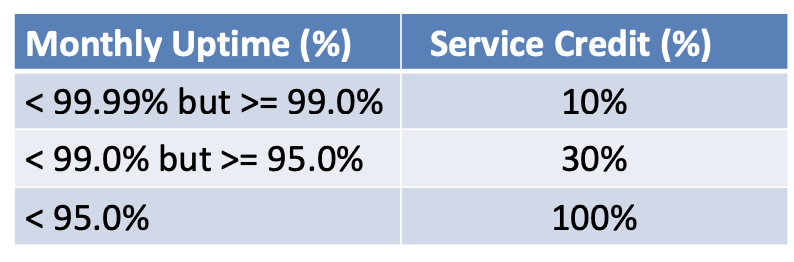
AWS SLA:
SaaS: Integrated Pricing Model
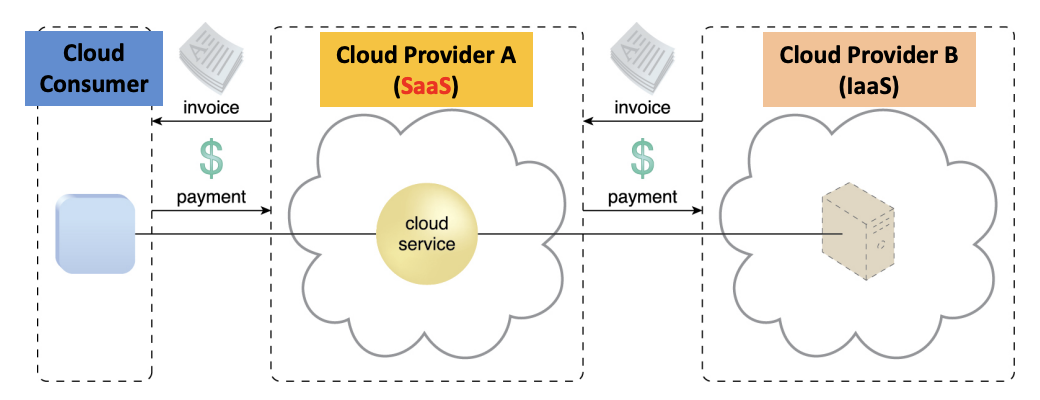
- Cloud consumer leases a SaaS product from Cloud Provider A. Cloud Provider A leases an IaaS environment (including the virtual server used to host the cloud service) from Cloud Provider B.
- Cloud consumer pays Cloud Provider A for providing the SaaS Cloud Provider A hosts the SaaS on Cloud Provider B and pays Cloud Provider B for the IaaS service
SaaS: Separate Pricing Model
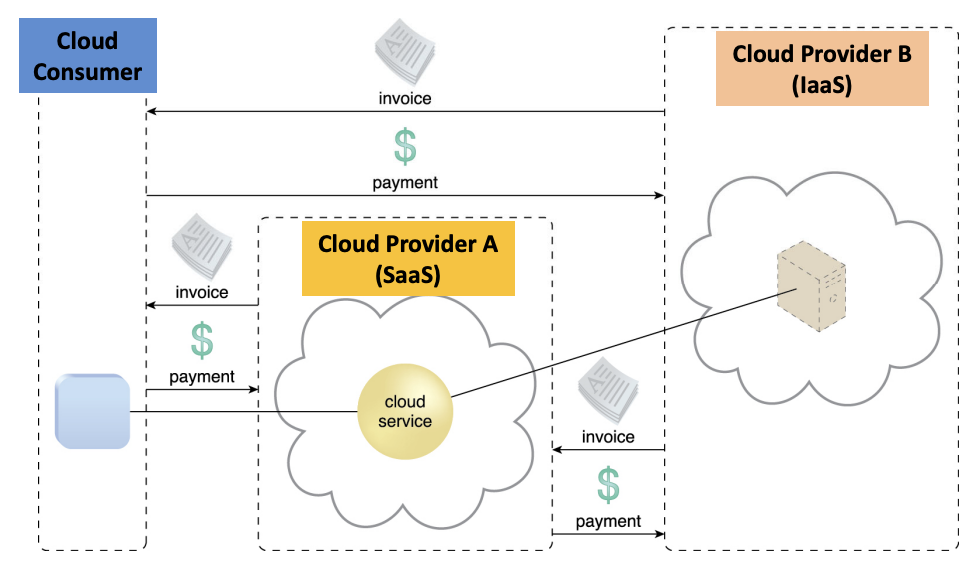
- Cloud consumer leases a virtual server from Cloud Provider B (IaaS) to host the SaaS service from Cloud Provider A (SaaS). Both leasing agreements may have been arranged for the cloud consumer by Cloud Provider A.
- There may still be some fees billed directly by Cloud Provider B to Cloud Provider A
Example: AWS Pricing
- Charges differ across region and depends on the perating costs (energy, communication and maintenance)
- On-demand
- multi-tenancy, pay by the second (minimum of 60 seconds)
- start and stop as you wish
- Reserved
- pay by the year - onetime upfront + pay as you go
- 3 types: light, medium and heavy utilization
- start or stop as needed
- Spot
- Bid for unused capacity
- Name your spot price and if market rate is less than your bid, you get the instance
- Instance automatically terminates if your spot price becomes less than current market rate
- Dedicated
- Instance runs in a VPC on hardware dedicated to a single customer
- Instances are physically isolated at the host hardware level from instances that belong to other AS accounts
Cost Metrics
- Financial analysis of cloud adoption
- Compare on-prem (total cost of ownership TCO) and cloud-based provisioning )utility-centric pay-per-use)
- Usage scenario
- Cloud consumer
- Cloud provider:
- private cloud - determine resource charging within an organization (IaaS)
- how to price a cloud service (SaaS), etc
Business Cost Metrics
Upfront costs:
- Capital expenses (Capex)
- Initial investment to fund IT resourcess
- Obtain resource, deploy and administer
- on-prem → high: hardware, software and deployment costs
- cloud-based → low: labor cost for setting up cloud environment
On-going costs:
- Operational expenses (Opex)
- Run and maintain IT resources: licensing fee, electricity, maintenance
- Higher for on-prem
Additional costs:
- Cost of capital
- Cost incurred to raise funds → if high, leasing cloud-based is justified
- Sunk costs
- Prior investment on existing IT resources
- If significant, cannot justify cloud-based
- Integration costs
- Effort needed to interoperate IT resources on new environment, e.g. new cloud platform
- High cost → cloud-based less appealing
- Locked-in costs
- Movement from 1 cloud provider to another
- high value → cloud-based less appealing
Cloud Usage Cost Metrics
- Network usage (data transfer): inbound, outbound and intra-cloud network traffic
- Total network traffic in bytes
- Accumulated over a pre-defined period, e.g. up to 1GB free, S$0.01/GB till 1TB and S$0.005/GB after 1TB per month
- Applicable to IaaS, PaaS, SaaS
- Inter-cloud:
- Data replication, synchronization, …
- May have different rates for inbound and outbound. Some providers may not charge for inbound
- Intra-cloud: Some provider may not charge for it
- Server usage (compute): on-demand and reserved VM allocation
- range of performance attributes: CPU, RAM, dedicated storage, …
- On-demand
- pay-per-use fee short term
- cumulative from server start to stop date
- IaaS, PaaS
- Reserved
- upfront cost for reservation
- start date to expiry date
- costs: daily/monthly/yearly
- IaaS, PaaS
- Cloud storage device (storage): on-demand storage allocation, I/O data transfers
- On-demand storage space
- size of storage space in bytes
- cumulative sum over date of allocation to release
- IaaS, PaaS, SaaS
- I/O data tranferred metric
- I/O data in bytes
- some providers may not charge (IaaS, PaaS)
- On-demand storage space
- Cloud service (service): subscription duration, number of users, number of transactions
- SaaS
- application subscription duration: cumulative sum from subscription start to expiry date
- number of nominated users, e.g. S$0.9/additional user per month
- number of transactions
- number of request response message exchanges, e.g. S$0.05 per 1000 transactions
- SaaS and PaaS
Total Cost of Ownership of a Datacenter
Capex = upfront investment depreciated over a certain timeframe such as construction cost of datacenter and purchase price of servers
Opex = recurring cost of running datacenter such as electricity costs, repairs and maintenance, salaries, etc